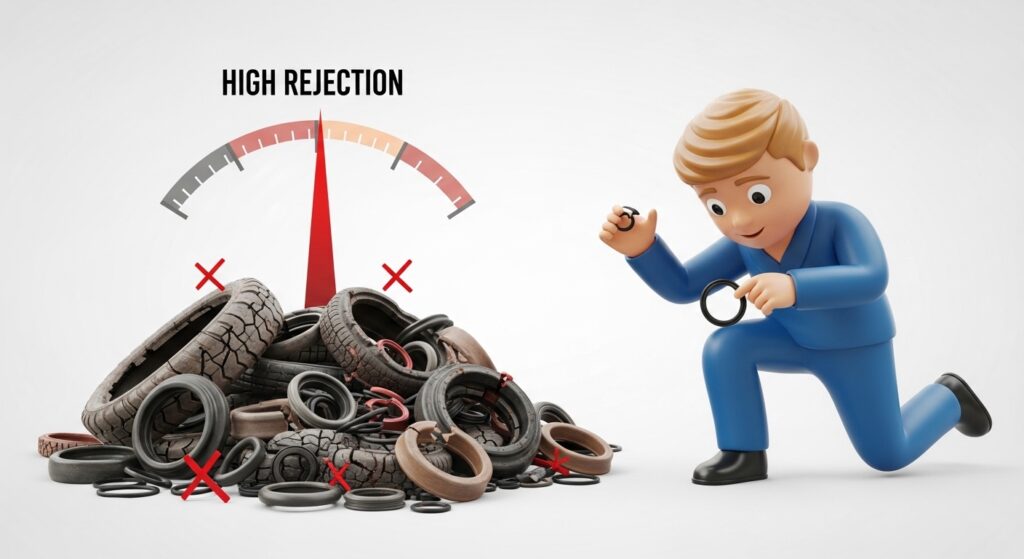
Arihant Reclamation Pvt. Ltd. supports rubber manufacturers in improving production efficiency by supplying high-quality antioxidants and rubber chemicals that help reduce rejection rates and enhance product durability.
In rubber manufacturing, rejection rate is one of the biggest hidden costs. Many MSME and OEM manufacturers face frequent issues such as cracking, poor tensile strength, uneven curing, and early aging failures. These defects not only increase material wastage but also lead to production delays, customer complaints, and financial losses.
One of the most overlooked causes of these issues is improper antioxidant selection or poor antioxidant systems in rubber compounding.
This blog explains how the right antioxidant system can significantly reduce rubber rejection rates and improve overall production performance.
What Causes High Rejection Rate in Rubber Manufacturing?
Before solving the problem, it is important to understand the root causes of rejection.
1. Oxidation During Processing
High temperatures during mixing and curing can initiate oxidation reactions, weakening the rubber structure even before the product is used.
2. Poor Heat Aging Resistance
If the compound cannot withstand heat, it loses flexibility and strength, leading to failures during testing.
3. Inconsistent Dispersion
Low-quality antioxidants or improper mixing lead to uneven distribution, causing weak zones in the product.
4. Compatibility Issues
Mismatch between antioxidants and accelerators (MBT, MBTS, CBS, TBBS, etc.) can affect curing behavior and final properties.
5. Low-Quality Raw Materials
Using inconsistent or impure antioxidants leads to unpredictable performance and batch rejection.
How Antioxidants Directly Impact Rejection Rate
Antioxidants are not just additives — they are stability controllers in rubber compounds.
A properly selected antioxidant system:
- Prevents premature degradation during processing
- Maintains polymer chain integrity
- Improves tensile strength retention
- Enhances heat resistance
- Reduces surface cracking and defects
This directly lowers rejection during:
- Quality testing
- Heat aging tests
- Field performance
Signs Your Antioxidant System is Causing Rejection
Many manufacturers overlook these warning signs:
- Rubber hardening after curing
- Surface cracks appearing early
- Drop in elongation values
- High variation between batches
- Increased rejection in aging tests
- Discoloration or uneven finish
If these issues are present, your antioxidant system needs evaluation.
How to Select the Right Antioxidant System
1. Choose Amine-Based Antioxidants for High-Performance Needs
For most industrial applications, amine antioxidants provide strong protection:
- TMQ → Excellent heat aging resistance
- TDQ → Good oxidation control
- Antioxidant SP Oil → Balanced cost-performance with good dispersion
2. Use Combination Systems for Better Results
Instead of relying on a single antioxidant:
👉 Use combinations like:
- TMQ + SP Oil
Benefits:
- Better thermal stability
- Improved dispersion
- Long-term protection
- Reduced volatility loss
3. Ensure Compatibility with Accelerators
Antioxidants must work smoothly with:
- MBT
- MBTS
- CBS
- TBBS
- TMTD
Incompatible combinations can lead to curing defects and rejection.
4. Focus on Dispersion Quality
Even the best antioxidant fails if not dispersed properly.
Ensure:
- Proper mixing temperature
- Adequate mixing time
- Uniform compound consistency
5. Test Before Bulk Production
Always perform:
- Heat aging test
- Tensile strength test
- Elongation retention test
This prevents large-scale rejection losses.
Practical Ways to Reduce Rejection Rate Immediately
Rubber manufacturers can implement these quick improvements:
✔ Standardize Antioxidant Dosage
Avoid under- or over-dosing.
✔ Use Consistent Supplier Material
Switching suppliers frequently causes batch variation.
✔ Improve Storage Conditions
Moisture and heat can degrade chemical performance.
✔ Monitor Mixing Parameters
Temperature and time directly affect antioxidant efficiency.
✔ Conduct Batch-wise Testing
Detect issues early before mass production.
Business Impact of Reducing Rejection Rate
Reducing rejection is not just technical — it is financial.
Cost Benefits:
- Lower raw material wastage
- Reduced reprocessing cost
- Improved production output
- Fewer customer complaints
- Lower warranty claims
Operational Benefits:
- Stable production cycles
- Better quality consistency
- Improved customer trust
Even a 2–5% reduction in rejection can significantly increase profitability.
Why Rubber Manufacturers Trust Arihant Reclamation Pvt. Ltd.
Arihant Reclamation Pvt. Ltd. supplies high-quality rubber antioxidants that help manufacturers achieve consistent performance and lower rejection rates.
Our product range includes:
- TMQ
- TDQ
- Antioxidant SP Oil
Along with a complete range of rubber accelerators:
ZDBC, ZDEC, MBT, MBTS, CBS, TBBS, TMTD, DPG, PVI and Zinc Oxide.
We support manufacturers with:
- Consistent industrial-grade quality
- Reliable bulk supply
- Competitive pricing
- Strong packaging standards
- Technical-grade purity
Our focus is to help rubber manufacturers improve efficiency and reduce production losses through dependable chemical solutions.
Conclusion
High rejection rates in rubber manufacturing are often linked to improper antioxidant systems rather than just processing errors. By selecting the right antioxidant combination, ensuring compatibility, and maintaining consistent quality, manufacturers can significantly reduce defects and improve production outcomes.
A well-optimized antioxidant system not only enhances product durability but also delivers measurable cost savings and operational efficiency.
📞 ARPL Product Support
Arihant Reclamation Pvt. Ltd.
📞 +91-8860732624
📧 arihantreclamation@gmail.com
🌐 https://arihantreclamationpvtltd.com/