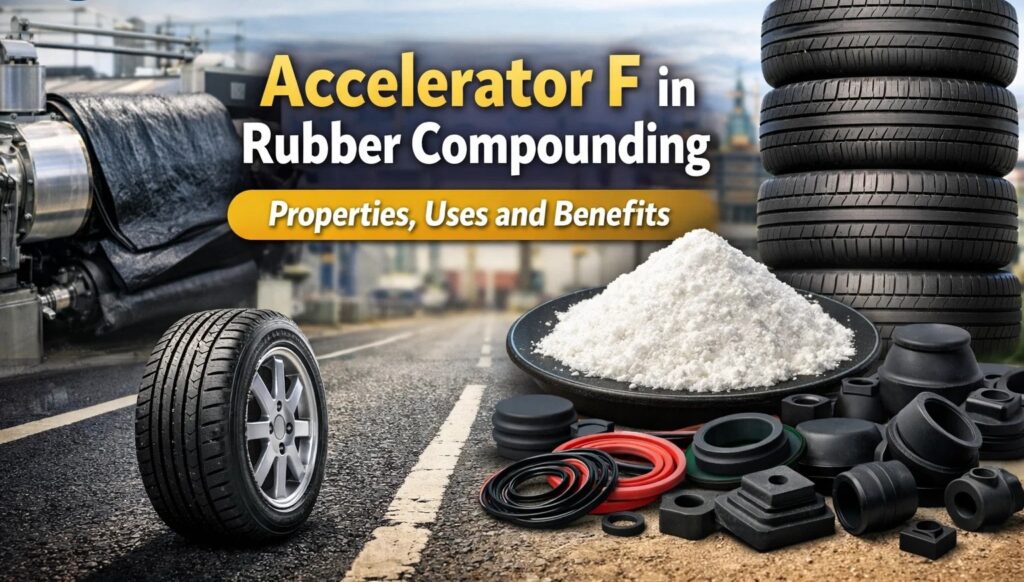
Rubber compounding relies on a carefully balanced combination of accelerators, activators, antioxidants, and processing additives to achieve desired curing behavior and final product performance. Among secondary accelerators used in rubber formulations, Accelerator F plays an important role in improving cure efficiency, enhancing physical properties, and supporting stable vulcanization systems.
Accelerator F is primarily used as a secondary accelerator in sulfur-based vulcanization. It is commonly combined with thiazole or sulfenamide accelerators to improve cure rate, modulus development, and crosslink density. Because of its compatibility with many rubber types and accelerator systems, Accelerator F is widely applied in mechanical rubber goods, molded rubber products, and industrial compounds.
Understanding the properties, uses, and benefits of Accelerator F helps compounders select the right formulation for achieving consistent processing, predictable curing, and reliable product performance.
What Is Accelerator F?
Accelerator F is a guanidine-type rubber accelerator. It functions mainly as a secondary accelerator and cure activator rather than a primary curing agent. When used with primary accelerators such as MBT or MBTS, Accelerator F improves their activity and strengthens sulfur crosslink formation.
Accelerator F does not typically provide sufficient curing speed on its own. Instead, it enhances the efficiency of other accelerators, leading to improved vulcanization behavior.
Accelerator F – Complete Technical Summary Table
| Parameter | Details |
|---|---|
| Chemical Name | Accelerator F (Guanidine-based rubber accelerator) |
| Chemical Family | Guanidine accelerator |
| Physical Form | Light-colored powder |
| Odor | Mild |
| Solubility | Insoluble in water |
| Main Function | Secondary accelerator and cure activator |
| Primary Role in Compounding | Enhances activity of primary accelerators |
| Typical Pairing Accelerators | MBT, MBTS |
| Cure Speed Effect | Increases cure rate |
| Effect on Scorch Safety | Low (does not provide scorch delay) |
| Influence on Crosslink Density | Increases |
| Effect on Modulus | Improves |
| Effect on Hardness | Improves |
| Effect on Tensile Strength | Improves |
| Blooming Tendency | Low |
| Processing Stability | Good when balanced |
| Recommended Dosage Range | 0.3 – 1.5 phr |
| Rubber Types Supported | NR, SBR, BR, NBR |
| Limited Suitability | EPDM, IIR |
| Typical Applications | Hoses, belts, molded rubber, gaskets, seals, mats |
| Function in Vulcanization | Promotes sulfur crosslink formation |
| Cure System Type | Sulfur-based systems |
| Storage Stability | Good |
| Shelf Life | Typically 12–24 months |
| Advantages | Better cure efficiency, improved strength, cost-effective |
| Limitations | Low scorch safety |
| Common Problems if Overused | Premature curing |
| Solution to Overuse | Reduce dosage or add retarder |
| Replacement/Alternative | DPG |
| Industrial Use Segment | Mechanical rubber goods |
| Compatibility with Activators | Zinc Oxide, Stearic Acid |
| Typical End Products | Conveyor belts, hoses, molded parts |
Chemical and Physical Properties of Accelerator F
| Property | Description |
|---|---|
| Chemical family | Guanidine accelerator |
| Appearance | Light-colored powder |
| Odor | Mild |
| Solubility | Insoluble in water |
| Compatibility | NR, SBR, NBR, BR |
| Blooming tendency | Low |
| Storage stability | Good |
These properties make Accelerator F easy to handle, stable during storage, and suitable for most conventional rubber compounding operations.
Role of Accelerator F in Rubber Compounding
Accelerator F contributes to rubber compounding in several important ways:
- Enhances activity of primary accelerators
- Improves cure rate
- Increases crosslink density
- Improves modulus and hardness
- Supports uniform vulcanization
Unlike delayed-action accelerators, Accelerator F does not provide significant scorch safety. Its main function is cure promotion.
How Accelerator F Works in Vulcanization
During vulcanization, Accelerator F interacts with primary accelerators and sulfur to form active sulfurating species. These species react more efficiently with rubber polymer chains, resulting in:
- Faster crosslink formation
- More uniform crosslink distribution
- Stronger rubber network
This mechanism explains why Accelerator F is often used in combination with thiazole accelerators such as MBT or MBTS.
Typical Accelerator Systems Using Accelerator F
| Primary Accelerator | Role of Accelerator F |
|---|---|
| MBT | Boosts cure speed |
| MBTS | Improves activation |
| CBS | Minor effect |
| TBBS | Minor effect |
| TMTD | Cure strengthening |
Accelerator F is most effective when paired with thiazole accelerators.
Recommended Dosage of Accelerator F
| Application Type | Typical Dosage (phr) |
|---|---|
| General rubber goods | 0.3 – 1.0 |
| Mechanical rubber parts | 0.5 – 1.2 |
| Hard rubber compounds | 0.6 – 1.5 |
Excessive dosage may reduce scorch safety and increase risk of premature curing.
Uses of Accelerator F in Rubber Products
Accelerator F is commonly used in:
- Rubber hoses
- Conveyor belts
- Rubber sheets
- Molded rubber goods
- Gaskets and seals
- Industrial rubber mats
- Mechanical rubber components
These products benefit from improved modulus, strength, and curing efficiency.
Benefits of Using Accelerator F
1. Improved Cure Efficiency
Accelerator F increases the effectiveness of primary accelerators, resulting in faster and more complete vulcanization.
2. Higher Modulus and Hardness
Compounds using Accelerator F generally show higher stiffness and improved load-bearing capability.
3. Better Tensile Strength
Crosslink density improvement leads to stronger rubber products.
4. Stable Processing
When properly balanced, Accelerator F does not significantly interfere with processing flow.
5. Cost-Effective Performance Enhancement
Small dosages can deliver measurable improvements in physical properties.
Comparison: Accelerator F vs DPG
| Parameter | Accelerator F | DPG |
|---|---|---|
| Chemical type | Guanidine | Guanidine |
| Primary role | Cure promoter | Cure promoter |
| Cure speed effect | Moderate | Moderate |
| Scorch safety | Low | Low |
| Best pairing | MBT, MBTS | MBT, MBTS |
| Typical use | Mechanical rubber | Mechanical rubber |
Both materials serve similar purposes, but selection depends on formulation preferences and performance targets.
Compatibility with Rubber Types
| Rubber Type | Compatibility |
|---|---|
| Natural Rubber (NR) | Excellent |
| SBR | Excellent |
| BR | Good |
| NBR | Good |
| EPDM | Limited |
| IIR | Limited |
Accelerator F is mainly used in sulfur-cured rubbers.
Processing Considerations
- Ensure uniform dispersion
- Avoid excessive dosage
- Balance with scorch retarders if needed
- Store in dry conditions
Proper processing control ensures consistent compound behavior.
Common Issues and Solutions
Issue: Compound cures too fast
Solution: Reduce Accelerator F or add retarder
Issue: Low modulus
Solution: Increase Accelerator F slightly
Issue: Poor tensile strength
Solution: Optimize Accelerator F with primary accelerator
Why Accelerator F Remains Important
Despite newer accelerator systems, Accelerator F continues to be widely used due to:
- Reliable performance
- Easy formulation integration
- Cost efficiency
- Proven industrial track record
It remains a practical choice for many rubber manufacturers.
Industry Perspective
Accelerator F is a valuable secondary accelerator that enhances vulcanization efficiency and mechanical performance when used correctly. Understanding its properties and interactions allows compounders to design stable, high-performance rubber formulations for industrial and mechanical applications.
ARPL Product Support
Arihant Reclamation Pvt. Ltd. supplies a complete range of rubber accelerators and additives including Accelerator F, MBT, MBTS, CBS, TBBS, TMTD, ZDEC, ZDBC, ZMBT, DPG, PVI, TMQ, TDQ, and Zinc Oxide for tyre and non-tyre rubber manufacturers across India.
📞 +91-8860732624
📧 arihantreclamation@gmail.com
🌐 https://arihantreclamationpvtltd.com/