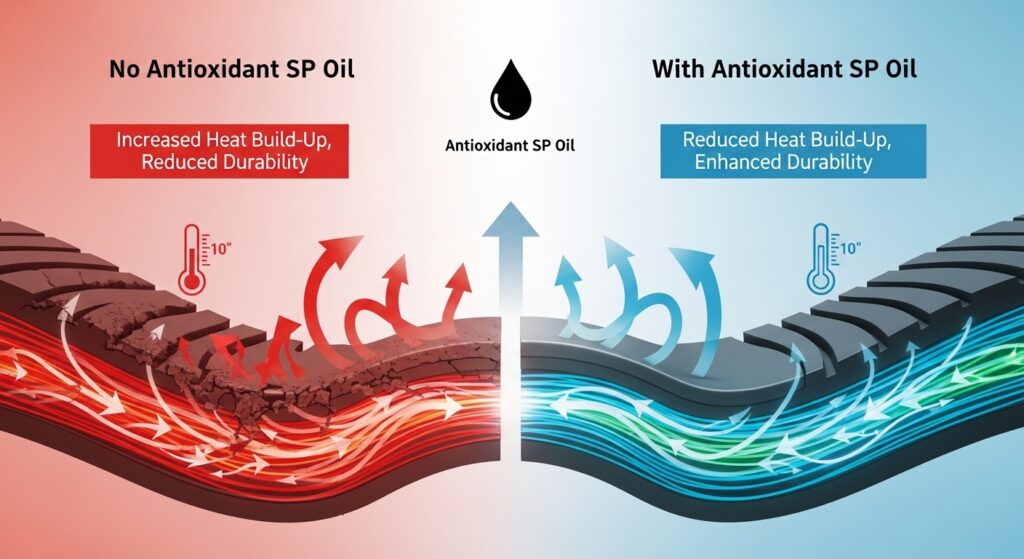
Arihant Reclamation Pvt. Ltd. supplies high-performance rubber antioxidants including Antioxidant SP Oil, widely used by tyre and non-tyre manufacturers to improve durability, reduce heat build-up, and enhance long-term performance in dynamic rubber applications.
In modern rubber manufacturing, especially in dynamic applications such as tyres, conveyor belts, and automotive components, heat build-up is one of the most critical factors affecting product performance and lifespan. Excessive internal heat generation leads to premature aging, mechanical degradation, and ultimately product failure.
This is where Antioxidant SP Oil plays a crucial role — not only in preventing oxidation but also in controlling heat-related degradation within rubber compounds.
What is Heat Build-Up in Rubber?
Heat build-up refers to the internal temperature rise in rubber materials during repeated deformation or dynamic loading.
Common Causes:
- Continuous flexing (tyres, belts)
- Internal friction (hysteresis loss)
- High-speed operation
- Poor compound formulation
- Inadequate antioxidant system
Effects of Heat Build-Up:
- Reduced tensile strength
- Loss of elasticity
- Surface cracking
- Increased wear and tear
- Early product failure
Why Dynamic Rubber Applications Are More Sensitive
Dynamic applications involve continuous movement, making them more vulnerable:
Examples:
- Tyres (constant rotation + road friction)
- Conveyor belts (continuous load movement)
- Engine mounts (vibration absorption)
- Rubber bushings (cyclic stress)
In such cases, even small increases in internal temperature can significantly reduce product life.
How Antioxidant SP Oil Helps Reduce Heat Build-Up
Antioxidant SP Oil contributes to heat management in multiple ways:
1. Reduces Oxidative Degradation at High Temperature
During dynamic use, heat accelerates oxidation. SP Oil:
- Neutralizes free radicals
- Interrupts oxidation chain reactions
- Protects polymer chains
👉 Result: Less heat-induced degradation
2. Improves Polymer Stability
Stable polymer chains generate less internal friction.
SP Oil helps:
- Maintain molecular integrity
- Reduce chain scission
- Improve elasticity retention
👉 Result: Lower hysteresis → reduced heat generation
3. Enhances Dispersion in Rubber Matrix
Being liquid-based, SP Oil provides:
- Better distribution in compound
- Uniform protection across material
- Reduced weak zones
👉 Result: Even stress distribution → less localized heat
4. Works Synergistically with Other Antioxidants
SP Oil is often used with:
- TMQ (for heat resistance)
- TDQ (for oxidation protection)
👉 Combined effect:
- Improved thermal stability
- Better long-term performance
5. Reduces Internal Friction (Indirect Effect)
By maintaining compound flexibility and preventing stiffness:
- Reduces energy loss during deformation
- Minimizes heat generation
Technical Comparison: With vs Without SP Oil
| Parameter | Without SP Oil | With SP Oil |
|---|---|---|
| Heat Build-Up | High | Reduced |
| Oxidation Resistance | Moderate | High |
| Elasticity Retention | Low | High |
| Crack Resistance | Poor | Improved |
| Product Life | Shorter | Longer |
Applications Where SP Oil is Most Effective
1. Tyre Industry
- Tread compounds
- Sidewall compounds
- Retread rubber
2. Conveyor Belts
- Continuous movement → high heat
- SP Oil improves durability
3. Automotive Components
- Engine mounts
- Bushings
- Vibration isolators
4. Industrial Rubber Goods
- Dynamic seals
- Rubber rollers
- Flexible hoses
Key Benefits for Manufacturers
Using Antioxidant SP Oil offers:
✔ Performance Benefits
- Reduced heat build-up
- Improved aging resistance
- Better mechanical stability
- Enhanced durability
✔ Production Benefits
- Lower rejection rate
- Consistent batch quality
- Improved processing behavior
✔ Business Benefits
- Reduced warranty claims
- Increased product life
- Better customer satisfaction
- Higher profitability
How to Use Antioxidant SP Oil Effectively
Recommended Practices:
- Use in combination with TMQ for best results
- Maintain proper dosage (avoid overuse)
- Ensure proper mixing for uniform dispersion
- Test compound under dynamic conditions
Common Mistakes to Avoid
- Using only solid antioxidants in high-dynamic applications
- Ignoring dispersion quality
- Overdosing without testing
- Poor storage of antioxidant chemicals
Why Manufacturers Choose Arihant Reclamation Pvt. Ltd.
Arihant Reclamation Pvt. Ltd. provides high-quality Antioxidant SP Oil along with a full range of rubber chemicals including:
- TMQ, TDQ
- ZDBC, ZDEC
- MBT, MBTS
- CBS, TBBS, TMTD
- DPG, PVI
- Zinc Oxide
Our Strengths:
- Consistent industrial-grade quality
- Reliable bulk supply
- Competitive pricing
- Strong packaging standards
- Trusted by rubber manufacturers across India
We help manufacturers improve compound performance, durability, and production efficiency.
Conclusion
Heat build-up is a critical challenge in dynamic rubber applications, directly affecting product performance and lifespan. Antioxidant SP Oil plays a vital role in reducing heat-related degradation by stabilizing polymer chains, improving dispersion, and enhancing overall compound performance.
By incorporating SP Oil into rubber formulations, manufacturers can achieve better durability, lower rejection rates, and improved operational efficiency.
📞 ARPL Product Support
Arihant Reclamation Pvt. Ltd.
📞 +91-8860732624
📧 arihantreclamation@gmail.com
🌐 https://arihantreclamationpvtltd.com/