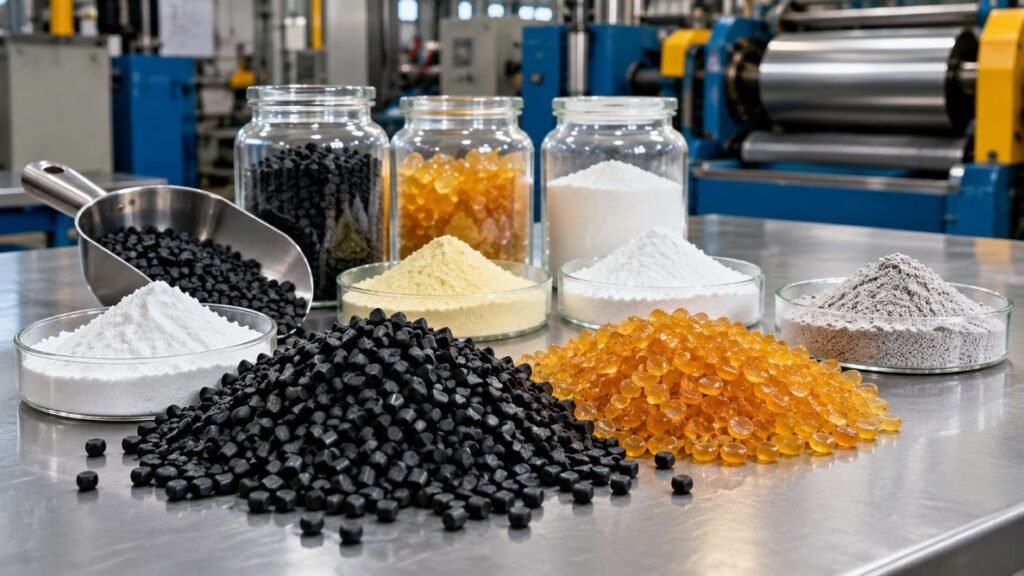
Rubber additive ingredients play an important role in the manufacturing of tyres, automotive components, industrial rubber products, footwear, hoses, conveyor belts and other rubber goods. These ingredients are added to natural rubber and synthetic rubber formulations to improve processing, control vulcanization, protect against ageing and achieve the physical properties required in finished products.
For rubber manufacturers, selecting the right combination of rubber additives is essential for achieving consistent product quality, processing efficiency, durability and performance.
Arihant Reclamation Pvt. Ltd. (ARPL) supplies a range of rubber processing chemicals, including rubber accelerators, antioxidants, retarders and zinc oxide. This page explains the major categories of rubber additive ingredients, their functions, applications and how manufacturers can select suitable chemicals for their formulations.
What Are Rubber Additive Ingredients?
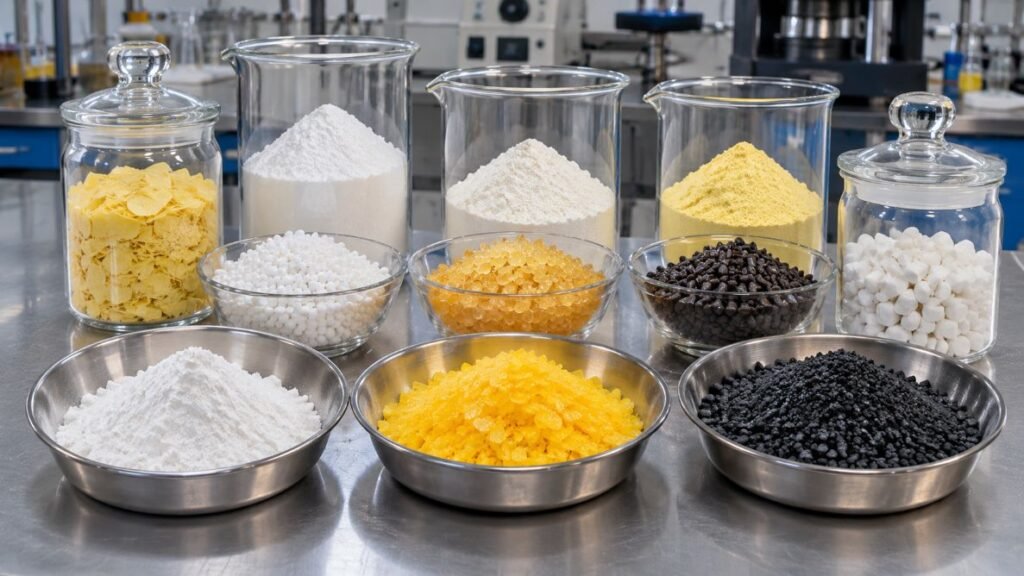
Rubber additive ingredients are chemicals and compounding materials incorporated into natural or synthetic rubber during manufacturing. They help control the mixing, processing and vulcanization stages and influence the characteristics of the finished rubber product.
Raw rubber alone may not provide all the properties required for demanding industrial applications. Manufacturers therefore combine rubber polymers with suitable additives such as vulcanizing agents, accelerators, activators, antioxidants, fillers, processing aids and other compounding ingredients.
The selection and quantity of each ingredient depend on the rubber polymer, manufacturing process, curing system, product design and required performance.
Main Types of Rubber Additive Ingredients and Their Functions
Rubber compounding ingredients are selected according to the performance requirements of the finished product. The main categories include vulcanizing agents, accelerators, activators, antioxidants, antiozonants, retarders, fillers, processing aids, plasticizers and specialty additives. Finale+2
1. Rubber Vulcanizing Agents
Vulcanizing agents are used to create crosslinks between rubber polymer chains. This process, known as vulcanization or curing, transforms the uncured rubber compound into a material with the required elastic and mechanical properties.
Common vulcanizing agents include:
- Sulphur
- Organic peroxides
- Metal oxide-based curing systems for selected elastomers
- Other specialised crosslinking agents
Sulphur is widely used in conventional curing systems for suitable unsaturated rubbers. Peroxide curing systems are used for certain elastomers and applications where different crosslink structures are required.
Common applications: Tyres, conveyor belts, rubber hoses, automotive rubber components, industrial seals and moulded rubber products.
2. Rubber Accelerators
Rubber accelerators increase the rate of vulcanization and help manufacturers control the curing process. They are important ingredients in many sulphur-based rubber compounding systems.
Different accelerator families provide different curing characteristics, including cure speed, scorch safety and processing behaviour.
| Rubber accelerator | Chemical category | Common role |
|---|---|---|
| MBT | Thiazole | Primary or secondary vulcanization accelerator |
| CBS | Sulfenamide | Delayed-action accelerator |
| MBTS | Thiazole disulphide | Vulcanization accelerator |
| TBBS | Sulfenamide | Delayed-action accelerator |
| TMTD | Thiuram | Fast accelerator and sulphur donor in suitable systems |
| ZDEC | Dithiocarbamate | Very fast accelerator |
| ZDBC | Dithiocarbamate | Fast accelerator |
| ZMBT | Dithiocarbamate-related accelerator | Accelerator used in suitable rubber curing systems |
| DTDM | Thiuram-type sulphur donor | Sulphur-donor ingredient in suitable curing systems |
| Accelerator F | Rubber accelerator | Used in specific rubber vulcanization formulations |
Why rubber accelerators are important:
- Help control vulcanization time.
- Support the required curing characteristics.
- Improve manufacturing efficiency when correctly selected.
- Help develop the required physical properties of cured rubber.
- Allow manufacturers to design curing systems for different rubber applications.
The correct accelerator depends on the polymer, sulphur system, processing temperature and desired cure characteristics.
3. Rubber Activators
Rubber activators improve the effectiveness of vulcanization accelerators. They are important components of many conventional sulphur curing systems.
The commonly used activator combination is zinc oxide and stearic acid.
| Activator ingredient | Function |
|---|---|
| Zinc Oxide (ZnO) | Participates in the activation of sulphur vulcanization systems |
| Stearic Acid | Works with zinc oxide to support accelerator activation |
| Other selected metal oxides | Used in specific elastomer and curing systems |
ARPL offers Zinc Oxide for rubber processing and industrial applications.
Applications: Tyre compounds, industrial rubber goods, automotive rubber components, rubber belts, hoses and other vulcanized products.
4. Rubber Antioxidants
Antioxidants are protective rubber additives that help reduce deterioration caused by oxidation and heat exposure. Rubber products may experience ageing during processing, storage and service, which can affect their physical properties.
Common antioxidant ingredients include:
| Antioxidant | Common designation | Main function |
|---|---|---|
| TMQ | TMQ / TDQ | Protection against oxidative and heat ageing |
| 6PPD | 6PPD | Antidegradant protection, including ozone-related protection |
| KY-616 / Wingstay L | KY-616 / Wingstay L | Antioxidant protection in suitable rubber compounds |
| MBI / MB | MBI / MB | Antioxidant used in selected rubber formulations |
| Antioxidant 445 | 445 | Specialty antioxidant for selected applications |
Benefits of rubber antioxidants:
- Help control oxidative ageing.
- Support resistance to heat-related deterioration.
- Help maintain rubber properties during service.
- Contribute to product durability when properly selected.
- Support the performance of rubber compounds exposed to demanding conditions.
5. Rubber Antiozonants
Antiozonants help protect susceptible rubber compounds from ozone attack. Ozone exposure can cause surface cracking, particularly in stretched rubber products containing ozone-sensitive polymer structures.
Common antiozonant materials include selected p-phenylenediamine derivatives and protective waxes.
Antiozonants are important in applications such as:
- Automobile tyres and sidewalls
- Automotive rubber components
- Rubber hoses
- Outdoor rubber products
- Industrial rubber seals
- Flexible rubber products exposed to outdoor conditions
Some rubber chemicals, such as 6PPD, provide both antioxidant and antiozonant functions. The protection offered depends on the compound and exposure conditions.
6. Rubber Retarders and Pre-Vulcanization Inhibitors
Rubber retarders are used to delay the onset of premature vulcanization during processing. They help improve processing safety when rubber compounds undergo mixing, extrusion, calendaring and moulding.
One recognised example is PVI, also known as CTP (N-cyclohexylthiophthalimide).
| Ingredient | Common name | Function |
|---|---|---|
| PVI / CTP | Pre-vulcanization inhibitor | Helps delay premature curing and improve scorch safety |
Retarders are particularly relevant when manufacturers need sufficient processing time before the final curing stage.
7. Rubber Fillers and Reinforcing Agents
Fillers are added to rubber compounds to modify physical properties, processing behaviour and material cost. Some fillers provide reinforcement, while others are mainly used as extenders or functional mineral ingredients.
| Filler | Main purpose |
|---|---|
| Carbon Black | Reinforcement, abrasion resistance and improvement of mechanical properties |
| Precipitated Silica | Reinforcement and modification of compound properties |
| Calcium Carbonate | Extending and modifying compound cost and properties |
| China Clay | Filler and compound modification |
| Talc | Functional mineral filler |
| Magnesium Carbonate | Used in selected rubber formulations |
| Other Mineral Fillers | Modify density, processing behaviour and other compound characteristics |
The type, particle characteristics and loading level of the filler can significantly influence the finished rubber’s properties. Finale+1
8. Rubber Processing Aids, Plasticizers and Softeners
Processing aids are used to improve the handling and processing of rubber compounds. They can help with mixing, material flow, filler dispersion, extrusion and moulding.
Common processing ingredients include:
- Process oils
- Plasticizers
- Softeners
- Lubricants
- Peptizers
- Tackifying resins
- Dispersing agents
- Anti-sticking agents
Their functions may include:
- Reducing compound viscosity.
- Improving mixing and filler dispersion.
- Supporting extrusion and mould flow.
- Modifying flexibility and hardness.
- Improving processing efficiency.
- Supporting material handling during manufacturing.
The selection depends on the rubber polymer, operating conditions, compatibility and final-product requirements.
9. Rubber Protective Waxes
Protective waxes are used in certain rubber compounds to provide a protective surface layer against environmental exposure, particularly ozone attack. They migrate towards the rubber surface under suitable conditions and form a protective barrier.
Applications include tyre sidewalls, automotive rubber components and outdoor rubber products.
10. Specialty Rubber Additives
Some rubber products require additional ingredients to achieve specific manufacturing or service requirements.
| Specialty additive | Main function |
|---|---|
| Pigments and Colourants | Provide the required colour |
| Flame Retardants | Improve flame-resistance characteristics |
| Blowing Agents | Create cellular or expanded rubber structures |
| Bonding Agents | Support rubber-to-metal or rubber-to-substrate bonding |
| Tackifiers | Improve tack and adhesion during processing |
| Coupling Agents | Improve compatibility between selected fillers and rubber |
| Antistatic Additives | Help control static electricity |
| Odour-Control Ingredients | Modify unwanted odour in selected applications |
| Reversion Inhibitors | Help control loss of properties associated with over-curing in susceptible systems |
Not every rubber formulation requires these additives. Their use depends on the product’s design and performance specifications.
Rubber Additive Ingredients Used in Different Industries
Rubber additives are selected according to the requirements of the finished product. Different industries use different combinations of rubber chemicals, fillers and processing ingredients.
| Industry | Common rubber additive ingredients | Applications |
|---|---|---|
| Tyre Manufacturing | Accelerators, zinc oxide, sulphur, antioxidants, carbon black and silica | Passenger tyres, truck tyres, two-wheeler tyres and tyre components |
| Automotive Industry | Accelerators, antioxidants, fillers, processing aids and protective agents | Bushes, seals, gaskets, hoses and vibration-control components |
| Conveyor Belt Manufacturing | Vulcanizing agents, accelerators, fillers and antioxidants | Industrial conveyor belts and material-handling systems |
| Rubber Hose Industry | Accelerators, activators, fillers, plasticizers and antioxidants | Industrial hoses, hydraulic hoses and flexible tubing |
| Footwear Industry | Accelerators, fillers, pigments, plasticizers and vulcanizing agents | Rubber soles, footwear components and shoe outsoles |
| Industrial Rubber Products | Accelerators, antioxidants, fillers and processing aids | Rubber sheets, mats, seals, rollers and moulded components |
| Electrical Industry | Fillers, curing agents, antioxidants and specialty additives | Selected cable insulation and protective rubber components |
| Construction Industry | Vulcanization chemicals, fillers and protective additives | Rubber expansion joints, seals, gaskets and vibration-control products |
How Rubber Additive Ingredients Work Together
Rubber additives are not normally selected as isolated ingredients. They work together as part of a complete rubber formulation.
For example, a conventional sulphur-cured rubber compound may contain:
- Base rubber: Natural rubber or a suitable synthetic rubber.
- Filler: Carbon black or silica to modify mechanical and processing properties.
- Activator: Zinc oxide and stearic acid to support the vulcanization system.
- Vulcanizing agent: Sulphur to form crosslinks during curing.
- Accelerator: CBS, MBTS, MBT or another suitable accelerator to control curing characteristics.
- Antioxidant: TMQ or 6PPD to provide protection against degradation.
- Retarder: PVI/CTP when additional scorch protection is required.
- Processing ingredients: Oils, softeners and other aids where needed.
This is an illustrative ingredient structure, not a universal manufacturing recipe. Actual formulations vary with polymer selection, product requirements, curing system and processing conditions. Wiley Online Library+2
What Does PHR Mean in Rubber Compounding?
PHR stands for Parts per Hundred Rubber. It is a standard measurement used by rubber manufacturers and compound developers to express the quantity of each ingredient relative to 100 parts of base rubber by weight.
For example, if a formulation contains 100 kg of rubber and 5 PHR of zinc oxide, it requires 5 kg of zinc oxide.
PHR helps manufacturers calculate and compare rubber compound formulations accurately. It is particularly important when adjusting accelerator levels, filler quantities, antioxidant content and curing ingredients.
Factors to Consider When Selecting Rubber Additive Ingredients
Selecting suitable rubber additives requires consideration of the manufacturing process and the intended performance of the finished product.
1. Rubber polymer compatibility
Check whether the additive is suitable for natural rubber, SBR, BR, NBR, EPDM or another selected elastomer.
2. Vulcanization requirements
Consider the required curing speed, scorch safety, curing temperature and crosslinking system.
3. Finished-product properties
Evaluate hardness, tensile strength, elongation, tear strength, abrasion resistance, flexibility and ageing requirements.
4. Processing conditions
Consider mixing temperature, extrusion, calendaring, moulding and curing conditions.
5. Chemical specifications
Review the purity, appearance, physical properties and other technical parameters of the selected chemical.
6. Quality consistency
Check batch consistency, product documentation and supplier quality-control procedures.
7. Cost and availability
Compare the technical suitability, purchasing price, order quantity, packaging and delivery arrangements.
Rubber Additive Ingredients Supplier in India – ARPL
Arihant Reclamation Pvt. Ltd. (ARPL) offers a range of rubber processing chemicals for manufacturers and industrial buyers. Our product portfolio includes important ingredients used in rubber vulcanization, compounding and protection systems.
Manufacturers searching for rubber additives suppliers in India, rubber accelerator suppliers, rubber antioxidant suppliers, zinc oxide suppliers and industrial rubber chemicals can explore our product range.
Explore ARPL Rubber Additive Products
| Product Category | Available Product Information |
|---|---|
| Rubber Accelerators | MBT, CBS, MBTS, TBBS |
| Thiuram and Dithiocarbamate Accelerators | TMTD, ZDEC, ZDBC, DTDM, ZMBT |
| Rubber Antioxidants | TMQ/TDQ, 6PPD, KY-616/Wingstay L, MBI/MB |
| Rubber Retarders | PVI/CTP |
| Rubber Activator | Zinc Oxide |
Visit the complete ARPL product catalogue to explore the listed rubber chemicals.
Please note that the rubber industry uses many additional ingredients, including sulphur, carbon black, silica, process oils, plasticizers and specialty additives. The product list above identifies ARPL’s relevant listed products; it does not imply that every category of rubber compounding ingredient is supplied by ARPL.
Why Choose the Right Rubber Additive Supplier?
For rubber manufacturers, choosing suitable chemical suppliers is an important part of maintaining product quality and production efficiency.
Consider these points when evaluating a rubber chemical supplier:
- Availability of relevant rubber accelerator and antioxidant products.
- Clear product specifications and technical documentation.
- Batch quality and consistency.
- Suitable packaging and storage information.
- Ability to discuss bulk purchasing requirements.
- Transparent commercial communication.
- Product suitability for the intended rubber application.
ARPL provides a range of rubber processing chemicals for industrial buyers seeking product information and supply enquiries.
Contact Arihant Reclamation Pvt. Ltd. for Rubber Additive Ingredients
Looking for rubber additive ingredients, rubber accelerators, antioxidants, vulcanization chemicals or zinc oxide for your manufacturing requirements?
Contact Arihant Reclamation Pvt. Ltd. (ARPL) to discuss product specifications, availability, bulk purchasing requirements and industrial rubber chemical enquiries.
Company Name: Arihant Reclamation Pvt. Ltd. (ARPL)
Phone: +91-8860-732-624 / +91-9625-671-802
Email: arihantreclamationpvtltd@gmail.com
Website: https://arihantreclamationpvtltd.com
Address: 40.3 km Milestone, GT Road, Bahalgarh, Sonepat, Haryana 131021, India.
Certifications and Compliance
- ISO 9001:2015 – Quality Management System
- ISO 14001:2015 – Environmental Management System
- REACH Compliance
Industry Memberships
- All India Rubber Industries Association
- IRMRI Membership
Corporate Registration Details
CIN: U25190DL2011PTC222968
Contact our team to discuss your rubber chemical requirements and explore the relevant products available in the ARPL portfolio.
Frequently Asked Questions About Rubber Additive Ingredients
1. What are rubber additive ingredients?
Rubber additive ingredients are chemicals and materials added to natural or synthetic rubber to improve processing, vulcanization, durability and finished-product properties. Common examples include accelerators, antioxidants, activators, fillers, vulcanizing agents and processing aids.
2. What are the main ingredients used in rubber manufacturing?
The main ingredients include natural or synthetic rubber, sulphur, zinc oxide, stearic acid, rubber accelerators, antioxidants, fillers, processing oils and specialty additives.
3. What are the most commonly used rubber additives?
Common rubber additives include MBT, CBS, MBTS, TBBS, TMTD, ZDEC, ZDBC, zinc oxide, TMQ, 6PPD and PVI/CTP. Other ingredients depend on the specific rubber formulation.
4. What is the function of rubber accelerators?
Rubber accelerators increase the rate of vulcanization and help control the curing process. Examples include CBS, MBTS, MBT, TBBS and TMTD.
5. Why is zinc oxide used in rubber compounds?
Zinc oxide acts as an activator in conventional sulphur vulcanization systems. It works with stearic acid and accelerators to support the curing process.
6. What is the difference between rubber antioxidants and antiozonants?
Antioxidants primarily help protect rubber against oxidative degradation, while antiozonants protect susceptible rubber compounds against ozone-related deterioration. Some chemicals, including 6PPD, provide both functions.
7. What is PVI in rubber manufacturing?
PVI stands for Pre-Vulcanization Inhibitor. It is also known as CTP and is used to help delay premature vulcanization and improve processing safety.
8. Which rubber additives are used in tyre manufacturing?
Tyre compounds may use zinc oxide, stearic acid, sulphur, rubber accelerators, antioxidants, antiozonants, carbon black, silica, processing oils and protective waxes. The exact ingredients depend on the tyre component and formulation.
9. What does PHR mean in rubber chemicals?
PHR means Parts per Hundred Rubber. It expresses the quantity of an ingredient relative to 100 parts by weight of the base rubber in a formulation.
10. How do I select the right rubber additive ingredients?
Selection depends on the rubber polymer, intended application, curing system, processing conditions, required physical properties, chemical compatibility and product specifications. Manufacturers should consult their rubber compound developer or technical team before changing a formulation.
11. Where can I find rubber additive ingredients suppliers in India?
You can explore the rubber accelerator, antioxidant, retarder and zinc oxide product range offered by Arihant Reclamation Pvt. Ltd. through its official product catalogue.