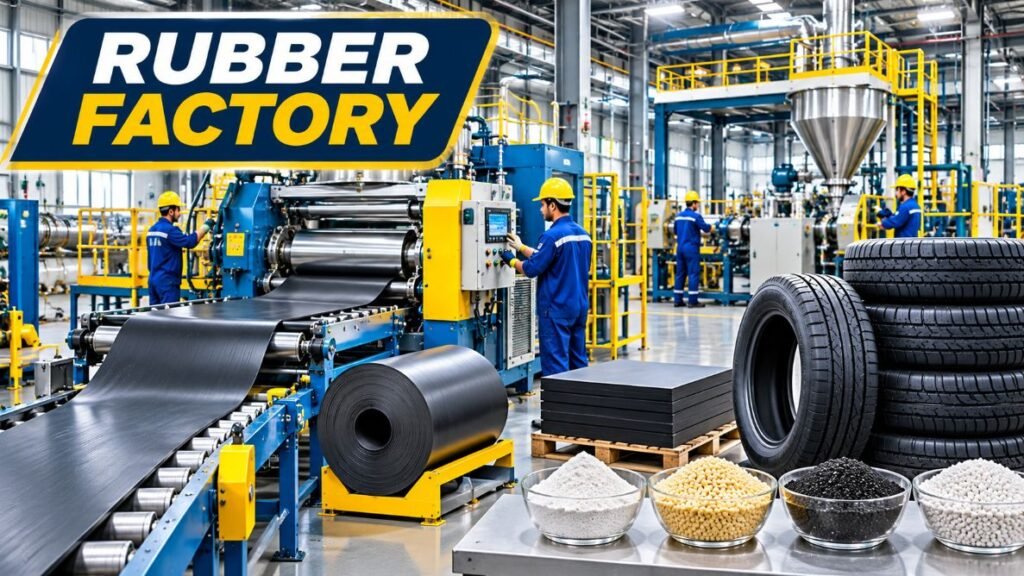
A rubber factory is an industrial manufacturing facility where natural rubber, synthetic rubber, latex or reclaimed rubber is processed into finished or semi-finished rubber products. Depending on its production capacity and business model, a rubber factory may manufacture tyres, tubes, rubber sheets, hoses, conveyor belts, automotive components, industrial seals, gaskets, footwear, gloves, rubber mats, moulded components, rubber rollers, vibration-control products and many other goods.
Modern rubber factories operate through a combination of raw material storage, chemical weighing, rubber mixing, milling, extrusion, calendaring, moulding, vulcanisation, finishing, quality testing, packaging and dispatch. Some factories specialise in only one process, while larger integrated facilities may perform several manufacturing operations under one roof.
Rubber manufacturing is an important industrial activity worldwide. Rubber products are used in automobiles, transportation, construction, infrastructure, agriculture, mining, engineering, healthcare, electrical equipment, household products, footwear and numerous other industries.
Arihant Reclamation Pvt. Ltd. (ARPL) is an India-based rubber chemicals company serving the rubber industry with a range of rubber accelerators, antioxidants, retarders and Zinc Oxide. Our product portfolio includes chemicals such as MBT, MBTS, CBS, TBBS, TMTD, ZDEC, ZDBC, ZMBT, TMQ/TDQ, 6PPD, PVI/CTP and Zinc Oxide. Rubber manufacturers, compounders and industrial buyers can explore our product range and contact our team for product information and supply enquiries.
1. What Is a Rubber Factory?

A rubber factory is a manufacturing unit designed to convert rubber polymers and other ingredients into usable products through mechanical processing and chemical curing.
The main activities inside a rubber factory may include:
- Purchasing and receiving natural or synthetic rubber.
- Receiving and storing rubber chemicals and compounding ingredients.
- Cutting, weighing and preparing raw rubber.
- Mixing rubber with fillers, oils, accelerators, antioxidants and other formulation ingredients.
- Milling and refining rubber compounds.
- Extruding rubber into continuous profiles, tubes and other shapes.
- Calendaring rubber into sheets or coating fabrics.
- Moulding rubber into specific product designs.
- Vulcanising or curing rubber using controlled heat and pressure.
- Cooling, trimming, grinding and finishing manufactured products.
- Inspecting and testing finished rubber goods.
- Packing, storing and dispatching products to customers.
The exact manufacturing process depends on the rubber product being manufactured.
2. Different Types of Rubber Factories Worldwide

Rubber factories can be classified according to their raw materials, manufacturing processes and finished products.
| No. | Type of Rubber Factory | Main Manufacturing Activities | Common Products |
|---|---|---|---|
| 1 | Tyre Manufacturing Factory | Rubber compounding, tyre component preparation, building and curing | Car, truck, bus, motorcycle and industrial tyres |
| 2 | Rubber Tube Factory | Extrusion, curing and finishing | Inner tubes, industrial tubes and flexible rubber tubing |
| 3 | Industrial Rubber Products Factory | Mixing, moulding, extrusion and fabrication | Industrial rubber components |
| 4 | Rubber Hose Factory | Extrusion, reinforcement, winding and curing | Hydraulic, industrial, automotive and water hoses |
| 5 | Conveyor Belt Factory | Rubber sheeting, fabric or steel-cord reinforcement and curing | Industrial conveyor belts |
| 6 | Rubber Sheet Factory | Milling, calendaring and sheet production | Rubber sheets, flooring and lining sheets |
| 7 | Rubber Moulding Factory | Compression, injection and transfer moulding | Seals, gaskets, bushes and custom components |
| 8 | Automotive Rubber Parts Factory | Compounding, moulding and extrusion | Engine mounts, bushings, seals and weatherstrips |
| 9 | Rubber Footwear Factory | Compounding, moulding and sole production | Rubber soles, slippers and footwear components |
| 10 | Rubber Gloves Factory | Latex preparation, dipping, leaching and curing | Industrial, household and examination gloves |
| 11 | Latex Products Factory | Latex compounding, dipping, foaming and drying | Balloons, gloves, foam products and dipped goods |
| 12 | Rubber Roller Factory | Metal-core preparation, rubber covering, curing and grinding | Industrial and printing rollers |
| 13 | Rubber Mat Factory | Mixing, moulding and curing | Floor mats, anti-fatigue mats and industrial mats |
| 14 | Rubber Seal and Gasket Factory | Precision moulding, cutting and finishing | O-rings, gaskets and sealing components |
| 15 | Rubber Foam Factory | Foam compounding, expansion, curing and cutting | Foam sheets, cushions and insulation products |
| 16 | Reclaimed Rubber Factory | Collection, processing, devulcanisation or other reclamation methods | Reclaimed rubber |
| 17 | Rubber Recycling Factory | Sorting, shredding, granulation and further processing | Rubber granules, crumb rubber and recovered materials |
| 18 | Rubber Band Factory | Compounding, extrusion, curing and cutting | Rubber bands and elastic rubber products |
| 19 | Rubber Flooring Factory | Mixing, sheet or tile moulding and curing | Rubber flooring tiles and rolls |
| 20 | Rubber Lining Factory | Rubber sheet preparation, bonding and curing | Tank, pipe and equipment linings |
A business planning a rubber factory should select its product category before purchasing machinery. A tyre manufacturing facility needs a very different production line from a small rubber gasket or hose manufacturing unit.
3. Outside Structure and Infrastructure of a Rubber Factory
A rubber factory is not limited to its production building. Its outside premises, utilities, storage facilities, safety arrangements and transport infrastructure are equally important.
3.1 Main Factory Building
The factory building normally contains the production floor, machinery installation area, raw material movement space, finished goods handling area and supporting facilities.
Important building considerations include:
- Adequate industrial floor space.
- Sufficient floor load-bearing capacity for heavy machinery.
- Suitable roof height for machinery and material handling.
- Industrial flooring suitable for equipment, forklifts and trolleys.
- Adequate ventilation and lighting.
- Clearly marked emergency exits.
- Separate storage areas for different materials.
- Suitable drainage and water management.
- Safe access for workers and maintenance teams.
- Provision for future machinery expansion.
3.2 Raw Material Storage Warehouse
Rubber factories require dedicated storage space for raw rubber, chemicals, fillers, packaging materials and other ingredients.
Common storage materials include:
- Natural rubber bales.
- Synthetic rubber.
- Reclaimed rubber.
- Carbon black.
- Silica and mineral fillers.
- Zinc Oxide.
- Rubber accelerators.
- Rubber antioxidants.
- Rubber retarders.
- Processing oils and plasticisers.
- Rubber chemicals and specialty additives.
- Fabric, steel cord and reinforcement materials.
- Packaging bags, cartons and pallets.
Chemicals must be stored according to their safety data sheets (SDS), compatibility, temperature requirements and applicable fire and environmental regulations. Incompatible chemicals should not be stored together.
3.3 Finished Goods Warehouse
This area is used to store manufactured rubber products before dispatch.
It may contain:
- Tyres and tubes.
- Rubber sheets and rolls.
- Industrial hoses.
- Conveyor belts.
- Moulded rubber components.
- Automotive rubber parts.
- Rubber seals and gaskets.
- Rubber mats and flooring.
- Rubber footwear.
- Packaged rubber products.
Storage conditions should protect products from excessive heat, sunlight, ozone, contamination, deformation and other factors that may affect product quality.
3.4 Loading and Unloading Area
A rubber factory generally requires a dedicated area for the movement of trucks, containers and material-handling equipment.
Common facilities include:
- Truck entry and exit gates.
- Loading platforms.
- Unloading bays.
- Forklift movement areas.
- Pallet storage zones.
- Weighbridge, where required.
- Material inspection area.
- Finished goods dispatch section.
3.5 Boiler and Steam Generation Area
Some rubber manufacturing processes require steam or controlled heating for curing and vulcanisation.
Depending on the production process, a factory may install:
- Industrial boiler.
- Steam distribution pipelines.
- Pressure vessels.
- Steam traps.
- Condensate recovery system.
- Water treatment equipment.
- Boiler feedwater pumps.
Boiler and pressure equipment installations require applicable safety inspections, approvals and operating permissions.
3.6 Electrical Substation and Power Supply
Rubber machinery can require substantial electrical power. The factory may need:
- Electrical transformer.
- Industrial distribution panels.
- Motor control centres.
- Power factor correction equipment.
- Cable trays and industrial wiring.
- Earthing and lightning protection.
- Emergency power arrangements.
- Generator or backup power system.
- Energy monitoring equipment.
The connected electrical load should be calculated from the selected machinery and utilities before factory construction.
3.7 Cooling Tower and Water Systems
Water may be required for cooling equipment, moulds, compressors and other industrial processes.
A factory may use:
- Cooling towers.
- Chillers.
- Industrial water pumps.
- Water storage tanks.
- Cooling water pipelines.
- Water filtration systems.
- Water treatment equipment.
- Wastewater collection and treatment systems.
The water system must be designed according to actual process requirements and local environmental rules.
3.8 Air Compressor Room
Compressed air is used in pneumatic systems, moulding machines, valves, automation and other production equipment.
Typical equipment includes:
- Screw air compressor.
- Air receiver tank.
- Air dryer.
- Air filters.
- Air distribution pipelines.
- Pressure regulators.
- Moisture separators.
3.9 Pollution Control and Environmental Facilities
Depending on the factory type, pollution-control facilities may include:
- Dust collection systems.
- Local exhaust ventilation.
- Fume extraction systems.
- Air filtration equipment.
- Scrubbers where required.
- Wastewater treatment plant.
- Oil and chemical spill containment.
- Solid waste segregation area.
- Scrap rubber storage.
- Industrial stormwater management.
The pollution-control design should reflect the materials handled and actual emissions or wastewater generated.
3.10 Other Outside Facilities
A larger rubber factory may also have:
- Administrative office.
- Security cabin.
- Employee parking.
- Canteen.
- Toilets and changing rooms.
- First-aid room.
- Fire water tank.
- Fire pump room.
- Green belt or landscaping.
- Maintenance workshop.
- Laboratory building.
- Waste storage area.
- Employee training room.
4. Inside a Rubber Factory – Complete Department Layout
A well-organised rubber factory separates production, storage, maintenance, testing and administrative activities.
| No. | Factory Department | Main Activities | Equipment or Facilities |
|---|---|---|---|
| 1 | Raw Material Receiving | Material unloading and inspection | Weighing scales, pallets, forklifts |
| 2 | Raw Material Warehouse | Storage of rubber and chemicals | Racks, bins, drums and pallets |
| 3 | Rubber Preparation | Bale cutting and rubber preparation | Bale cutter, guillotine |
| 4 | Chemical Weighing | Measuring ingredients according to formulations | Precision scales, weighing stations |
| 5 | Mixing Department | Mixing rubber and compounding ingredients | Internal mixer, Banbury mixer |
| 6 | Milling Department | Refining and sheeting rubber | Two-roll mixing mill |
| 7 | Extrusion Department | Producing continuous rubber profiles | Rubber extruder |
| 8 | Calendaring Department | Producing rubber sheets and fabric-coated materials | Rubber calender |
| 9 | Moulding Department | Forming products in moulds | Compression and injection moulding machines |
| 10 | Vulcanisation Department | Curing rubber under controlled conditions | Curing presses, autoclaves and ovens |
| 11 | Assembly Department | Joining or building product components | Assembly tables, winding and joining equipment |
| 12 | Cooling Department | Cooling products after curing | Cooling racks and conveyors |
| 13 | Finishing Department | Trimming, grinding and surface finishing | Trimming machines, grinders |
| 14 | Quality Control Laboratory | Testing raw materials and finished products | Laboratory instruments |
| 15 | Maintenance Department | Machinery repair and preventive maintenance | Workshop tools and spare parts |
| 16 | Packaging Department | Product packing and labelling | Packing machines and weighing scales |
| 17 | Finished Goods Warehouse | Storage and stock control | Racks, pallets and inventory systems |
| 18 | Dispatch Department | Order preparation and shipment | Loading equipment and dispatch systems |
Not every factory requires every department. A specialised moulded rubber unit may not need a full calendaring line, while a tyre factory requires specialised tyre-building and curing operations.
5. Raw Materials Used in Rubber Factories
Rubber manufacturing requires a base polymer and, depending on the product, a combination of fillers, activators, accelerators, antioxidants, processing aids, curing ingredients and other additives.
5.1 Natural Rubber
Natural rubber is obtained from latex harvested from rubber trees and processed into commercial forms.
Common grades and forms include:
- Ribbed Smoked Sheets (RSS).
- Technically Specified Rubber (TSR).
- Standard Malaysian Rubber (SMR) grades.
- Natural rubber block grades.
- Concentrated natural latex.
Natural rubber is used in tyres, industrial rubber products, footwear, hoses, vibration-control products and many other applications.
5.2 Synthetic Rubber
Synthetic rubber is manufactured through chemical polymerisation processes.
Common types include:
| Rubber Type | Full Name | Common Applications |
|---|---|---|
| SBR | Styrene Butadiene Rubber | Tyres, footwear and general rubber products |
| BR | Butadiene Rubber | Tyres and wear-resistant products |
| NBR | Nitrile Butadiene Rubber | Oil-resistant seals, hoses and gaskets |
| EPDM | Ethylene Propylene Diene Monomer | Automotive seals, roofing and weather-resistant products |
| CR | Chloroprene Rubber | Industrial hoses, belts and protective components |
| IIR | Butyl Rubber | Inner tubes, seals and air-retaining products |
| HNBR | Hydrogenated Nitrile Butadiene Rubber | High-performance automotive and industrial seals |
| Silicone Rubber | Silicone Elastomer | Electrical, medical and temperature-resistant components |
| FKM | Fluoroelastomer | Chemical-resistant and high-temperature sealing products |
The selected polymer depends on the final product’s mechanical, thermal, chemical and environmental requirements.
5.3 Rubber Fillers
Fillers are used to modify processing, cost, stiffness, reinforcement and other compound properties.
Examples include:
- Carbon black.
- Silica.
- Calcium carbonate.
- Clay.
- Talc.
- Other mineral fillers.
The filler selection and loading depend on the formulation and required product performance.
5.4 Activators
Activators help improve the efficiency of certain vulcanisation systems.
Common examples include:
- Zinc Oxide.
- Stearic acid.
Zinc Oxide is widely used as an activator in conventional sulphur vulcanisation systems, generally together with stearic acid and rubber accelerators.
5.5 Rubber Accelerators
Rubber accelerators are used to control and speed up vulcanisation reactions.
Common rubber accelerators include:
- MBT – Mercaptobenzothiazole.
- MBTS – Dibenzothiazole Disulfide.
- CBS – N-Cyclohexyl-2-benzothiazolesulfenamide.
- TBBS – N-tert-Butyl-2-benzothiazolesulfenamide.
- TMTD – Tetramethylthiuram Disulfide.
- ZDEC – Zinc Diethyldithiocarbamate.
- ZDBC – Zinc Dibutyldithiocarbamate.
- ZMBT – Zinc 2-Mercaptobenzothiazole.
- DTDM – 4,4′-Dithiodimorpholine.
- Accelerator F and other specialised accelerator grades.
The accelerator is selected according to the polymer, cure system, processing conditions, scorch safety and final product specifications.
5.6 Rubber Antioxidants and Antiozonants
Antioxidants help protect rubber compounds against oxidative degradation. Antiozonants are used in appropriate formulations to help protect susceptible rubber products from ozone-related cracking.
Examples include:
- TMQ/TDQ.
- 6PPD.
- MBI/MB.
- KY-616/Wingstay L.
- Antioxidant 445.
The choice depends on polymer compatibility, exposure conditions, product requirements and applicable chemical regulations.
5.7 Rubber Retarders
Retarders are used in selected rubber formulations to improve processing safety by delaying premature vulcanisation.
An example is:
- PVI/CTP – N-(Cyclohexylthio)phthalimide.
5.8 Other Rubber Compounding Ingredients
Depending on the application, rubber factories may also use:
- Sulphur and other curing agents.
- Processing oils and plasticisers.
- Tackifying resins.
- Peptisers.
- Rubber processing aids.
- Waxes.
- Bonding agents.
- Pigments and colourants.
- Blowing agents.
- Speciality functional additives.
These materials are not all required in every formulation. Their selection must be based on the product design, technical requirements, safety data and regulatory compliance.
6. Machines Used in a Rubber Factory
Machinery selection depends on the production process, product size, material type, production volume and required automation level.
| No. | Machine Name | Main Function | Where It Is Used |
|---|---|---|---|
| 1 | Rubber Bale Cutter | Cuts large rubber bales into smaller pieces | Raw rubber preparation |
| 2 | Hydraulic Bale Cutter | Cuts rubber bales using hydraulic force | Rubber preparation |
| 3 | Internal Mixer | Mixes rubber with chemicals and fillers | Rubber compounding |
| 4 | Banbury Mixer | High-intensity internal rubber mixing | Tyre and industrial rubber factories |
| 5 | Kneader Mixer | Mixes and kneads rubber compounds | Rubber and specialty compound production |
| 6 | Two-Roll Mixing Mill | Mixes, refines and sheets rubber | Compounding and milling |
| 7 | Three-Roll Mill | Specialised milling and refining applications | Selected rubber and polymer operations |
| 8 | Rubber Extruder | Produces continuous rubber profiles | Hoses, tubes, strips and seals |
| 9 | Rubber Calender | Produces sheets and coats fabric | Sheets, belts and tyre components |
| 10 | Compression Moulding Machine | Moulds rubber using heat and pressure | Gaskets, bushes and moulded products |
| 11 | Rubber Injection Moulding Machine | Injects rubber compound into mould cavities | Precision rubber components |
| 12 | Transfer Moulding Machine | Transfers compound into mould cavities | Complex moulded products |
| 13 | Vulcanising Press | Cures rubber products in moulds | Rubber moulding |
| 14 | Autoclave | Uses controlled heat and pressure for curing | Hoses, linings and selected rubber products |
| 15 | Continuous Vulcanisation Line | Cures continuously processed rubber profiles | Extruded rubber products |
| 16 | Rubber Cutting Machine | Cuts rubber sheets and profiles | Product preparation and finishing |
| 17 | Rubber Grinding Machine | Grinds products to required dimensions | Rollers and precision components |
| 18 | Trimming Machine | Removes excess rubber from moulded products | Finishing |
| 19 | Rubber Buffing Machine | Prepares rubber surfaces | Retreading and selected bonding operations |
| 20 | Tyre Building Machine | Assembles tyre components | Tyre manufacturing |
| 21 | Tyre Curing Press | Cures assembled tyres | Tyre manufacturing |
| 22 | Latex Dipping Line | Dips formers into prepared latex | Gloves and dipped products |
| 23 | Latex Compounding Equipment | Prepares latex formulations | Latex factories |
| 24 | Rubber Foam Production Equipment | Produces cellular rubber | Foam products |
| 25 | Rubber Shredder | Cuts waste rubber into smaller pieces | Recycling |
| 26 | Rubber Granulator | Produces rubber granules | Recycling |
| 27 | Rubber Powder Grinding System | Produces fine rubber powder | Recycling and reclaimed material processing |
| 28 | Industrial Oven | Provides controlled heating | Selected curing and post-curing processes |
| 29 | Cooling Conveyor | Cools manufactured products | Production and finishing |
| 30 | Automatic Weighing System | Measures raw materials and ingredients | Compounding |
| 31 | Dust Collection System | Collects airborne dust | Chemical handling and mixing |
| 32 | Fume Extraction System | Controls process fumes | Mixing, curing and finishing |
| 33 | Air Compressor | Supplies compressed air | Factory utilities |
| 34 | Cooling Tower | Removes heat from cooling water | Factory utilities |
| 35 | Boiler | Generates steam | Steam-based curing and utilities |
| 36 | Water Treatment Plant | Treats water for required uses | Factory utilities |
| 37 | Effluent Treatment Plant | Treats wastewater where required | Environmental management |
| 38 | Laboratory Testing Equipment | Tests rubber properties | Quality control |
| 39 | Weighing Scales | Measures raw materials and finished products | Warehouse and production |
| 40 | Packaging Machine | Packs finished rubber goods | Dispatch |
6.1 Machinery Selection Before Purchasing
Before ordering equipment, a factory owner should confirm:
- Product type and design.
- Polymer type and formulation.
- Required production capacity.
- Machine size and working volume.
- Heating and cooling requirements.
- Electrical load.
- Steam or compressed-air requirements.
- Automation level.
- Mould dimensions and tooling.
- Installation and foundation requirements.
- Spare parts availability.
- Operator training.
- Safety guarding and emergency-stop arrangements.
- Maintenance requirements.
- Manufacturer support and warranty terms.
A machine should not be purchased simply because it is common in the rubber industry. It must match the actual production process.
7. Rubber Manufacturing Process – Step by Step
A typical solid-rubber manufacturing process follows several stages. Some factories use a different sequence or omit certain processes.
Step 1: Raw Material Procurement
The factory purchases natural rubber, synthetic rubber and the ingredients required for the selected product.
Incoming materials should be checked against purchase specifications, supplier documents and applicable quality requirements.
Step 2: Raw Material Inspection and Storage
Materials are inspected, identified and stored under suitable conditions.
The factory should maintain:
- Supplier details.
- Batch or lot numbers.
- Certificates of analysis where applicable.
- Safety data sheets.
- Storage instructions.
- Inventory records.
- Material traceability.
Step 3: Rubber Bale Cutting
Large rubber bales may be cut into smaller pieces to facilitate handling and mixing.
Step 4: Chemical Weighing
Each ingredient is weighed according to the approved rubber formulation.
Accurate weighing is important because incorrect quantities can affect cure behaviour, processing, product dimensions and performance.
Step 5: Rubber Mixing and Compounding
Rubber is mixed with selected fillers, oils, activators, accelerators, antioxidants and other ingredients.
Depending on the process, mixing may be performed in:
- Internal mixers.
- Banbury mixers.
- Kneaders.
- Two-roll mills.
The mixing sequence, temperature, time and energy input are controlled according to the compound specification.
Step 6: Milling and Refining
The mixed compound may be processed through a two-roll mill for further mixing, homogenisation, sheeting or preparation for the next production operation.
Step 7: Extrusion, Calendaring or Moulding Preparation
The compound is shaped according to the product.
- Extrusion creates continuous profiles, strips, tubes and hoses.
- Calendaring produces rubber sheets and coated fabrics.
- Moulding prepares rubber for specific shapes using mould cavities.
- Fabrication combines rubber with reinforcement or other components.
Step 8: Product Building or Assembly
Some products require multiple components to be assembled before curing.
Examples include tyre components, reinforced hoses, conveyor belts and fabric-reinforced products.
Step 9: Vulcanisation or Curing
Vulcanisation is a chemical process that creates crosslinks within rubber polymers, giving the material its required elastic and mechanical properties.
Depending on the product, curing may take place using:
- Compression moulding presses.
- Injection moulding machines.
- Autoclaves.
- Continuous vulcanisation lines.
- Other controlled heating systems.
Curing conditions must be developed and validated for the actual compound and product.
Step 10: Cooling
Products are cooled under suitable conditions before inspection and further handling.
Step 11: Trimming and Finishing
Excess rubber, flash or unwanted material is removed. Some products may require grinding, buffing, bonding, coating, painting or additional finishing.
Step 12: Quality Inspection
Finished products are inspected for appearance, dimensions, defects and performance requirements.
Step 13: Packaging and Labelling
Products are packed, identified and labelled according to customer requirements and applicable regulations.
Step 14: Storage and Dispatch
Finished products are stored under appropriate conditions and dispatched against customer orders.
8. Different Rubber Manufacturing Processes
8.1 Rubber Mixing
Rubber mixing combines the base polymer with the ingredients needed to achieve the target compound properties.
Important controls include:
- Ingredient weighing accuracy.
- Mixing sequence.
- Mixing temperature.
- Mixing time.
- Rotor speed.
- Energy input.
- Compound uniformity.
- Batch identification.
8.2 Rubber Extrusion
Extrusion pushes rubber compound through a die to create a continuous shape.
Products include:
- Rubber tubes.
- Sealing strips.
- Weatherstrips.
- Rubber profiles.
- Hoses.
- Industrial strips.
8.3 Rubber Calendaring
Calendaring uses rollers to produce sheets or apply rubber to fabric or other reinforcement materials.
It is used in applications such as:
- Rubber sheets.
- Conveyor belts.
- Tyre components.
- Rubber-coated fabrics.
- Industrial membranes.
8.4 Compression Moulding
A measured quantity of rubber compound is placed in a heated mould and compressed to produce the required shape.
It is widely used for:
- Rubber gaskets.
- O-rings.
- Bushes.
- Mountings.
- Seals.
- Custom industrial parts.
8.5 Injection Moulding
Rubber compound is prepared and injected into mould cavities under controlled conditions. This process is used for repeatable production of suitable precision components.
8.6 Transfer Moulding
Rubber compound is placed in a transfer chamber and forced into mould cavities. It is useful for certain complex moulded products.
8.7 Latex Dipping
Formers are dipped into prepared latex compounds, followed by suitable processing, drying and curing operations.
Common products include:
- Gloves.
- Balloons.
- Dipped rubber goods.
- Certain medical and industrial latex products.
8.8 Vulcanisation
Vulcanisation is used to develop the final properties of rubber compounds through controlled curing chemistry.
The cure system may use sulphur-based or other suitable crosslinking systems depending on the rubber polymer and product requirements.
9. Products Manufactured in Rubber Factories
Rubber factories manufacture a broad range of products for consumer, commercial and industrial use.
Automotive and Transportation Products
- Car tyres.
- Truck tyres.
- Bus tyres.
- Motorcycle tyres.
- Inner tubes.
- Engine mounts.
- Suspension bushes.
- Rubber seals.
- Door and window weatherstrips.
- Automotive hoses.
- Vibration dampers.
- Rubber grommets.
- Fuel and fluid system components.
Industrial Rubber Products
- Industrial hoses.
- Hydraulic hoses.
- Conveyor belts.
- Rubber sheets.
- Rubber rollers.
- Rubber linings.
- Rubber seals.
- Industrial gaskets.
- Rubber expansion joints.
- Vibration isolation pads.
- Industrial moulded parts.
Construction and Infrastructure Products
- Waterproofing membranes.
- Rubber flooring.
- Bridge bearings.
- Expansion joints.
- Pipe seals.
- Roofing products.
- Anti-vibration components.
- Protective rubber linings.
Electrical and Engineering Products
- Cable insulation components.
- Electrical seals.
- Insulating mats.
- Rubber grommets.
- Protective covers.
- Engineering moulded parts.
Healthcare and Latex Products
- Latex gloves.
- Selected medical rubber components.
- Rubber tubing.
- Dipped latex products.
- Certain rubber seals and closures.
Product specifications and medical suitability must be established through the relevant testing and regulatory approvals.
Consumer and Household Products
- Rubber mats.
- Rubber bands.
- Slippers and footwear components.
- Rubber balls.
- Household seals.
- Floor coverings.
- Rubber grips.
- Protective pads.
Agriculture and Mining Products
- Agricultural hoses.
- Conveyor belts.
- Rubber liners.
- Industrial tyres.
- Protective rubber sheets.
- Irrigation-related rubber components.
- Wear-resistant rubber parts.
10. Quality Control Laboratory in a Rubber Factory
Quality control is essential because rubber performance depends on the polymer, formulation, processing conditions and curing system.
A rubber factory may conduct the following tests depending on its products and customer specifications.
| No. | Test | What It Evaluates |
|---|---|---|
| 1 | Mooney Viscosity | Processing characteristics of uncured rubber |
| 2 | Rheometer Test | Cure behaviour and vulcanisation characteristics |
| 3 | Tensile Strength Test | Resistance to pulling force |
| 4 | Elongation at Break | Extension before failure |
| 5 | Hardness Test | Resistance to indentation |
| 6 | Specific Gravity Test | Density of the rubber compound |
| 7 | Compression Set Test | Ability to recover after compression |
| 8 | Tear Strength Test | Resistance to tearing |
| 9 | Abrasion Resistance Test | Resistance to surface wear |
| 10 | Rebound Resilience Test | Elastic rebound behaviour |
| 11 | Ageing Test | Changes after controlled heat or ageing exposure |
| 12 | Ozone Resistance Test | Resistance to ozone cracking |
| 13 | Dimensional Inspection | Product size and tolerances |
| 14 | Visual Inspection | Surface defects and appearance |
| 15 | Adhesion Test | Bond strength between rubber and other materials |
| 16 | Electrical Testing | Electrical properties of suitable rubber products |
| 17 | Chemical Resistance Test | Behaviour in specified chemicals and environments |
A factory should select test methods and acceptance limits based on product standards, customer specifications and applicable regulations. Not every test is necessary for every rubber product.
11. Workers and Employees Required in a Rubber Factory
The number of employees depends on the production capacity, automation, shift pattern and product category.
Typical positions include:
| Position | Main Responsibility |
|---|---|
| Factory Manager | Overall factory operations |
| Production Manager | Production planning and output |
| Production Supervisor | Daily shop-floor supervision |
| Rubber Technologist | Compound development and process control |
| Chemical Engineer | Chemical and process-related work |
| Mechanical Engineer | Machinery and mechanical maintenance |
| Electrical Engineer | Electrical systems and equipment |
| Quality Control Manager | Quality systems and product inspection |
| Laboratory Technician | Testing and laboratory records |
| Mixing Operator | Rubber mixing and compounding |
| Milling Operator | Operating rubber mills |
| Extrusion Operator | Operating extrusion lines |
| Moulding Operator | Operating moulding machines |
| Curing Operator | Controlling curing operations |
| Maintenance Technician | Equipment maintenance |
| Warehouse Manager | Raw material and finished goods inventory |
| Procurement Executive | Purchasing materials and equipment |
| Safety Officer | Occupational safety and compliance |
| Environmental Officer | Environmental management |
| Packing Staff | Packing and labelling |
| Dispatch Staff | Order preparation and shipment |
| Accounts Staff | Financial and commercial records |
| HR Staff | Recruitment and employee administration |
Workers should receive training appropriate to the machinery, chemicals and tasks they handle.
12. Safety Equipment and Worker Protection in a Rubber Factory
Rubber factories use heavy machinery, hot surfaces, chemicals, powders, oils, compressed air and sometimes flammable materials. Safety planning must be included from the design stage.
Personal Protective Equipment (PPE)
Depending on the task and risk assessment, workers may require:
- Safety helmets.
- Safety shoes.
- Chemical-resistant gloves.
- Heat-resistant gloves.
- Safety goggles.
- Face shields.
- Suitable protective clothing.
- Hearing protection.
- Respiratory protection selected for the actual exposure.
- High-visibility clothing where required.
Machine Safety
Important machinery safety measures include:
- Fixed and interlocked guards.
- Emergency-stop systems.
- Nip-point protection.
- Safe operating procedures.
- Restricted access to hazardous areas.
- Proper maintenance and inspection.
- Lockout/tagout procedures during maintenance.
- Safe procedures for clearing machine blockages.
- Operator training and supervision.
Two-roll mills, internal mixers, calenders and other powerful machines can cause severe injuries if not properly guarded and operated.
Chemical Safety
A factory should maintain:
- Safety data sheets for chemicals.
- Chemical inventory.
- Correct chemical labels.
- Suitable storage and segregation.
- Spill response equipment.
- Worker training.
- Local exhaust ventilation where needed.
- Exposure monitoring where required.
- Emergency procedures.
Fire Safety
Fire safety arrangements may include:
- Suitable fire extinguishers.
- Fire alarms.
- Hydrant systems where required.
- Sprinkler systems where required.
- Emergency exits.
- Evacuation plans.
- Fire detection equipment.
- Electrical inspection.
- Safe storage of flammable liquids.
- Hot-work permits.
- Fire drills and training.
The appropriate fire protection system must be designed according to the building, materials, fire load and local fire authority requirements.
13. Licences, Registrations and Legal Permissions for Opening a Rubber Factory Worldwide

There is no single worldwide rubber factory licence. Every country has its own factory, environmental, fire, labour, chemical, building and business regulations.
The legal requirements also differ according to:
- Country and state.
- Factory location.
- Land-use classification.
- Number of workers.
- Installed machinery power.
- Type of rubber manufacturing.
- Chemicals and solvents handled.
- Boiler and pressure equipment.
- Wastewater and air emissions.
- Whether the factory manufactures tyres, latex products, moulded components or recycled rubber.
- Whether products are supplied to regulated industries.
13.1 Common Categories of Permissions Around the World
| No. | Licence or Approval Category | Why It May Be Required |
|---|---|---|
| 1 | Business Registration | Legal establishment of the company |
| 2 | Industrial Land-Use Approval | Permission to use the land for industrial activity |
| 3 | Building Plan Approval | Approval of factory construction and layout |
| 4 | Factory Registration or Licence | Authorisation under applicable factory legislation |
| 5 | Environmental Permit | Approval for relevant emissions, discharges and waste |
| 6 | Air Emission Permit | Control of regulated air pollutants |
| 7 | Wastewater or Discharge Permit | Control of industrial wastewater |
| 8 | Hazardous Waste Authorisation | Management of regulated hazardous waste |
| 9 | Fire Department Approval | Fire safety compliance |
| 10 | Electrical Installation Approval | Compliance of electrical infrastructure |
| 11 | Boiler Registration | Approval for regulated boilers |
| 12 | Pressure Vessel Inspection | Safety inspection where applicable |
| 13 | Labour Registration | Compliance with employment and worker laws |
| 14 | Occupational Health and Safety Compliance | Protection of workers |
| 15 | Chemical Storage Permission | Applicable controls for hazardous chemicals |
| 16 | Import and Export Registration | Required for relevant international trade |
| 17 | Product Certification | Compliance with relevant product standards |
| 18 | Weights and Measures Registration | Where regulated weighing or packaged goods rules apply |
| 19 | Water Use Permission | Where abstraction or industrial water permits are required |
| 20 | Waste Management Registration | Where required for waste handling and disposal |
Not every approval applies to every factory. The exact list must be confirmed with the local industrial development authority, environmental regulator, factory inspectorate and other competent authorities before construction or operation.
13.2 Factory Setup and Licence Checklist in India
For entrepreneurs planning to establish a rubber factory in India, the following are important areas to investigate.
A. Company and Business Registration
- Private Limited Company, LLP, partnership or proprietorship registration, depending on the chosen structure.
- PAN and applicable tax registrations.
- GST registration where applicable.
- Udyam/MSME registration, if eligible.
- Import Export Code (IEC), if importing or exporting goods.
- Business bank account and accounting setup.
B. Land and Building Permissions
- Industrial land allotment or lawful industrial land purchase.
- Land-use and zoning verification.
- Building plan approval.
- Factory building and layout approval where required.
- Completion or occupancy permissions where applicable.
- Local authority approvals.
C. Factory and Labour Permissions
- Factory registration and licence under the applicable legislation.
- Compliance with applicable occupational safety and working-condition rules.
- Employee records and statutory registrations.
- Applicable EPFO and ESIC registrations.
- Contract labour compliance where applicable.
- Working hours, welfare, safety and employment records.
India’s labour law framework and implementation requirements should be checked against the current rules and notifications applicable to the factory’s location and commencement date.
D. Pollution Control and Environmental Permissions
- Consent to Establish from the relevant State Pollution Control Board or Pollution Control Committee, where applicable.
- Consent to Operate before commencing regulated operations, where applicable.
- Air pollution control compliance.
- Wastewater treatment and discharge permissions, where applicable.
- Hazardous waste authorisation, where applicable.
- Applicable waste management and disposal records.
- Environmental clearance, if the specific project falls under a category requiring it.
E. Fire and Industrial Safety
- Fire department approval or NOC, as applicable.
- Fire safety equipment and systems.
- Emergency evacuation plan.
- Electrical safety compliance.
- Machinery guarding and safety systems.
- Boiler registration and inspection, where applicable.
- Pressure equipment inspection, where applicable.
- Chemical storage and handling compliance.
F. Other Registrations and Product Requirements
- Legal Metrology compliance where applicable.
- BIS certification or other product certification where a product is covered by a compulsory requirement or a customer/market standard.
- Applicable packaging and labelling rules.
- Import and export compliance.
- Product-specific approvals for regulated markets or applications.
Important: This is a planning checklist, not a legal determination that every listed licence is compulsory for every rubber factory. Requirements can change, and some approvals depend on the factory’s exact process, capacity, site and materials.
14. International Regulations and Standards for Rubber Factories
Rubber factories selling domestically or internationally may need to comply with different laws and technical standards.
International Quality and Management Standards
- ISO 9001 – Quality management systems.
- ISO 14001 – Environmental management systems.
- ISO 45001 – Occupational health and safety management systems.
- ISO/IEC 17025 – Competence of testing and calibration laboratories, where applicable.
- Product-specific ASTM, ISO, EN, JIS or national standards.
Certification is generally voluntary unless a contract, regulator or market access requirement makes it necessary. A factory should not claim certification unless it has a valid certificate covering the relevant scope.
Chemical Regulations and Market Requirements
Depending on the country and market, manufacturers and chemical suppliers may need to address:
- REACH requirements in the European Union.
- CLP classification, labelling and packaging requirements in the European Union.
- UK REACH in Great Britain.
- TSCA requirements in the United States, where applicable.
- GHS-based chemical classification and labelling.
- Safety Data Sheet requirements.
- Chemical inventory and notification obligations.
- Restrictions on specific substances.
- Customer restricted-substance lists.
A factory exporting rubber goods must check the requirements applicable to its actual chemicals, products, customers and destination markets.
15. Environmental Management in a Rubber Factory
Rubber manufacturing can generate dust, fumes, wastewater, scrap rubber, used oils, packaging waste and other industrial waste streams.
A responsible factory should identify its environmental impacts and install suitable controls.
Air Pollution Control
Potential sources include:
- Rubber powder and chemical dust.
- Carbon black handling.
- Mixing and milling operations.
- Rubber curing fumes.
- Solvent vapours from selected processes.
- Boilers and fuel combustion.
- Grinding and finishing operations.
Possible control systems include:
- Local exhaust ventilation.
- Dust extraction.
- Bag filters.
- Suitable filtration systems.
- Fume extraction.
- Process enclosure.
- Scrubbers where technically and legally appropriate.
- Emission monitoring where required.
Wastewater Management
Wastewater may arise from cleaning, cooling, process operations, equipment washing and other factory activities.
A factory should identify each wastewater stream and determine whether treatment, recycling, discharge permission or off-site disposal is required.
Solid and Hazardous Waste
Potential waste streams include:
- Rubber scrap.
- Rejected products.
- Used oils.
- Chemical containers.
- Contaminated cleaning materials.
- Dust collector residues.
- Wastewater treatment sludge.
- Packaging waste.
- Metal and maintenance scrap.
Waste should be classified correctly and handled through authorised systems where required.
Energy and Resource Efficiency
Factories may improve resource efficiency through:
- Efficient motors and drives.
- Preventive maintenance.
- Heat recovery.
- Cooling-water optimisation.
- Compressed-air leak control.
- Energy monitoring.
- Process optimisation.
- Material recovery and scrap reduction.
16. Rubber Factory Layout and Production Planning
The factory layout should support a logical movement of materials from receiving to finished goods dispatch.
A typical process flow may look like this:
Raw Material Receiving → Inspection → Raw Material Storage → Chemical Weighing → Rubber Mixing → Milling → Extrusion / Calendaring / Moulding → Vulcanisation → Cooling → Finishing → Quality Inspection → Packaging → Finished Goods Storage → Dispatch
A factory should avoid unnecessary movement of materials between departments.
Important Layout Planning Factors
- Separate raw material and finished goods areas.
- Safe chemical storage.
- Adequate machine spacing.
- Forklift and pedestrian movement separation.
- Suitable ventilation and extraction.
- Fire exits and emergency access.
- Utility rooms and maintenance access.
- Quality laboratory location.
- Waste collection areas.
- Space for future expansion.
Production Capacity Planning
Production capacity should be calculated using:
- Machine output per hour.
- Operating hours per shift.
- Number of shifts.
- Planned maintenance downtime.
- Changeover time.
- Rejection and scrap rate.
- Labour availability.
- Raw material supply.
- Curing cycle time.
- Packaging and dispatch capacity.
The slowest production stage may become the factory’s bottleneck, even when other machines have higher capacities.
17. How to Open a Rubber Factory – Step-by-Step Business Setup Guide
Entrepreneurs should prepare a detailed feasibility study before investing in land, buildings and machinery.
Step 1: Select the Rubber Product
Decide what the factory will manufacture.
Examples:
- Rubber hoses.
- Rubber sheets.
- Tyres.
- Rubber seals and gaskets.
- Automotive rubber components.
- Rubber mats.
- Rubber footwear.
- Industrial rubber moulded products.
- Latex gloves.
- Reclaimed rubber.
Step 2: Research the Market
Study:
- Potential customers.
- Competitors.
- Market demand.
- Product prices.
- Import competition.
- Export opportunities.
- Required quality standards.
- Customer approval processes.
- Expected order volumes.
Step 3: Prepare a Detailed Project Report
A project report should cover:
- Product selection.
- Production capacity.
- Machinery requirements.
- Factory land and building.
- Raw material requirements.
- Manpower.
- Power and water.
- Environmental controls.
- Licences and permissions.
- Working capital.
- Sales projections.
- Operating expenses.
- Financial projections.
- Break-even analysis.
- Major risks.
Step 4: Select the Factory Location
Evaluate:
- Industrial zoning.
- Road and transport connectivity.
- Availability of electricity.
- Water supply.
- Labour availability.
- Proximity to suppliers and customers.
- Environmental restrictions.
- Waste disposal facilities.
- Scope for expansion.
- Local industrial infrastructure.
Step 5: Finalise Machinery
Obtain quotations from suitable machinery manufacturers and compare technical specifications, output capacity, safety features, energy requirements, installation costs and after-sales service.
Step 6: Arrange Raw Material Suppliers
Identify reliable sources for:
- Natural rubber.
- Synthetic rubber.
- Fillers.
- Zinc Oxide.
- Accelerators.
- Antioxidants.
- Retarders.
- Other required ingredients.
Approve suppliers using technical specifications, samples, documentation and quality checks.
Step 7: Obtain Applicable Permissions
Complete the required land, building, factory, environmental, fire, labour and other approvals before the relevant construction, installation or operating stages.
Step 8: Construct and Prepare the Factory
Complete the building, flooring, utilities, ventilation, drainage, storage, fire protection and other infrastructure.
Step 9: Install and Commission Machinery
Install machines according to manufacturer instructions, verify foundations and utilities, test safety systems and conduct commissioning.
Step 10: Develop Rubber Compounds and Products
Develop formulations and validate processing conditions. Product development may require support from experienced rubber technologists and laboratory testing.
Step 11: Recruit and Train Employees
Recruit production, technical, quality, maintenance, warehouse and safety personnel.
Step 12: Conduct Trial Production
Run trial batches, check product dimensions and performance, identify process problems and correct them before commercial production.
Step 13: Establish Quality and Traceability Systems
Maintain batch records, incoming inspection, process controls, testing reports, product identification and customer complaint procedures.
Step 14: Start Commercial Production
Begin production after the required approvals, commissioning, safety checks and product validation are completed.
18. Investment and Cost of Opening a Rubber Factory
The investment required for a rubber factory varies significantly. A small rubber moulding unit and a large integrated tyre factory cannot be compared using one standard budget.
The total project cost may include:
| Investment Area | Examples |
|---|---|
| Land | Industrial plot or leased factory premises |
| Building | Production shed, warehouse and office |
| Machinery | Mixers, mills, presses, extruders and other equipment |
| Moulds and Tooling | Product-specific moulds, dies and tools |
| Utilities | Transformer, compressor, boiler and cooling systems |
| Pollution Control | Dust extraction, fume control and wastewater treatment |
| Laboratory | Testing instruments and quality equipment |
| Licences and Approvals | Regulatory applications and professional fees |
| Raw Materials | Initial polymer and chemical inventory |
| Manpower | Recruitment and training |
| Packaging | Bags, cartons, labels and pallets |
| Working Capital | Salaries, utilities, inventory and operating expenses |
Factors That Influence Factory Investment
- Type of rubber products.
- Daily or monthly production capacity.
- Degree of automation.
- New or used machinery.
- Imported or locally manufactured machinery.
- Land and building cost.
- Electrical power requirements.
- Boiler and utility requirements.
- Mould and tooling complexity.
- Environmental and fire protection requirements.
- Product testing requirements.
- Initial working capital.
There is no reliable universal price for opening a rubber factory. A proper investment estimate requires the product, capacity, machinery configuration, location and level of automation.
19. Raw Material Purchasing and Rubber Chemical Suppliers
A rubber factory must maintain consistent raw material quality to produce consistent finished goods.
Buyers generally evaluate suppliers on:
- Product specifications.
- Batch-to-batch consistency.
- Technical documentation.
- Certificate of Analysis (COA), where applicable.
- Safety Data Sheet (SDS).
- Packaging quality.
- Storage and handling requirements.
- Supply capacity.
- Delivery arrangements.
- Commercial terms.
- Technical support.
Rubber Chemicals Commonly Used in Manufacturing
| Rubber Chemical | Main Function | Common Relevance |
|---|---|---|
| Zinc Oxide | Activator in conventional sulphur cure systems | Rubber compounding |
| MBT | Primary accelerator in selected cure systems | General rubber goods |
| MBTS | Accelerator with different cure characteristics | Tyres and industrial rubber |
| CBS | Delayed-action accelerator | Tyres and industrial rubber |
| TBBS | Delayed-action accelerator | Tyre and industrial applications |
| TMTD | Ultra-accelerator and sulphur donor in selected systems | Rubber compounding |
| ZDEC | Fast accelerator | Selected rubber formulations |
| ZDBC | Fast accelerator | Selected rubber formulations |
| ZMBT | Accelerator | Rubber compounding |
| TMQ/TDQ | Antioxidant | Protection against oxidative ageing |
| 6PPD | Antioxidant and antiozonant | Dynamic rubber applications |
| MBI/MB | Antioxidant | Selected rubber formulations |
| KY-616/Wingstay L | Antioxidant | Selected rubber formulations |
| PVI/CTP | Retarder | Scorch safety in selected cure systems |
| DTDM | Sulphur donor | Selected vulcanisation systems |
The suitability of each chemical depends on the polymer, formulation, cure system, processing conditions, regulatory restrictions and final product.
20. Common Problems Faced by Rubber Factories
Rubber manufacturers may face production, quality, procurement and operational challenges.
| Problem | Possible Causes | General Areas to Investigate |
|---|---|---|
| Uneven Mixing | Incorrect sequence, mixing conditions or equipment | Mixing procedure and batch controls |
| Poor Surface Finish | Compound, mould or processing issues | Formulation and mould condition |
| Scorching | Premature vulcanisation | Cure system and processing temperature |
| Low Tensile Strength | Polymer, filler, dispersion or cure problems | Compound formulation and testing |
| Poor Adhesion | Surface preparation or bonding system | Adhesion process and materials |
| Excessive Product Rejection | Process variation or incorrect specifications | Quality controls and operator training |
| Dimensional Variation | Mould, temperature or pressure variation | Tooling and process controls |
| High Scrap Generation | Setup, material or production problems | Root-cause analysis |
| Inconsistent Cure | Compound variation or equipment conditions | Rheometer results and curing controls |
| Excessive Dust | Powder handling and extraction issues | Enclosure and dust collection |
| Excessive Fumes | Heating and ventilation issues | Process control and local exhaust |
| High Energy Consumption | Inefficient equipment or operating practices | Energy audit and maintenance |
| Machinery Downtime | Wear, breakdown or poor maintenance | Preventive maintenance planning |
Problems should be investigated using process records, compound testing, equipment inspection and controlled trials rather than changing chemicals without technical evaluation.
21. Rubber Factory Documentation and Records
A professionally managed rubber factory should maintain appropriate operational and compliance documentation.
Business and Legal Records
- Company registration documents.
- Land and building documents.
- Factory approvals and licences.
- Environmental permissions.
- Fire safety approvals.
- Applicable labour registrations.
- Insurance policies.
- Import and export records.
Raw Material Records
- Purchase orders.
- Supplier details.
- Incoming inspection reports.
- Batch numbers.
- Certificates of Analysis.
- Safety Data Sheets.
- Stock registers.
- Material issue records.
Production Records
- Approved formulations.
- Batch mixing sheets.
- Machine operating records.
- Production reports.
- Process parameters.
- Rejection records.
- Scrap records.
- Maintenance logs.
Quality Records
- Raw material test reports.
- Compound test reports.
- Finished product inspection reports.
- Calibration records.
- Non-conformance reports.
- Corrective action records.
- Customer complaints.
- Product traceability records.
Safety and Environmental Records
- Risk assessments.
- Worker training records.
- Incident reports.
- Fire drill records.
- Equipment inspection records.
- Waste disposal records.
- Environmental monitoring reports.
- Chemical inventory and SDS records.
22. Major Rubber Manufacturing Countries Around the World
Rubber manufacturing takes place across Asia, Europe, North America, South America, Africa and other regions.
Important manufacturing and rubber-processing countries include:
| No. | Country | Rubber Industry Activities |
|---|---|---|
| 1 | China | Tyres, automotive components, industrial rubber and footwear |
| 2 | India | Tyres, tubes, industrial rubber, automotive components and rubber chemicals |
| 3 | Japan | Tyres, automotive rubber, precision components and industrial products |
| 4 | United States | Tyres, hoses, seals, industrial rubber and engineered components |
| 5 | Germany | Automotive rubber, industrial seals, hoses and engineered products |
| 6 | Thailand | Natural rubber processing, tyres, latex and rubber goods |
| 7 | Indonesia | Natural rubber processing, tyres and industrial rubber |
| 8 | Malaysia | Latex gloves, rubber products and natural rubber processing |
| 9 | Vietnam | Tyres, footwear, rubber products and natural rubber processing |
| 10 | South Korea | Tyres, automotive rubber and industrial components |
| 11 | France | Tyres and industrial rubber products |
| 12 | Italy | Industrial hoses, seals, belts and engineered rubber products |
| 13 | United Kingdom | Industrial rubber, seals and specialised components |
| 14 | Brazil | Tyres, industrial rubber and natural rubber processing |
| 15 | Turkey | Tyres, automotive rubber and industrial products |
| 16 | Spain | Tyres and industrial rubber goods |
| 17 | Mexico | Automotive rubber, tyres and industrial components |
| 18 | Canada | Industrial rubber and automotive-related products |
| 19 | Sri Lanka | Natural rubber products, gloves and industrial rubber goods |
| 20 | Taiwan | Tyres, automotive and industrial rubber components |
| 21 | Poland | Tyres and industrial rubber products |
| 22 | Czech Republic | Automotive and industrial rubber components |
| 23 | Netherlands | Specialised rubber and polymer products |
| 24 | Sweden | Industrial rubber and engineered components |
| 25 | Finland | Industrial and specialised rubber products |
| 26 | South Africa | Tyres, industrial rubber and mining-related products |
| 27 | Egypt | Tyres and industrial rubber products |
| 28 | Argentina | Tyres and general rubber manufacturing |
| 29 | Colombia | Tyres, footwear and industrial rubber goods |
| 30 | Australia | Industrial rubber, mining and engineering products |
This is a selection of countries with rubber manufacturing or processing activity, not a complete ranking or an exhaustive list of every country.
23. How to Choose a Rubber Factory or Rubber Manufacturer
Businesses purchasing rubber products should assess manufacturers according to their product requirements and technical capabilities.
Important points include:
- Manufacturing experience.
- Product range.
- Production capacity.
- Machinery and technology.
- Quality management system.
- Product testing facilities.
- Raw material traceability.
- Certifications relevant to the product.
- Customer references.
- Export experience.
- Delivery capabilities.
- Technical support.
- Compliance with destination-market requirements.
For specialised rubber components, buyers should also provide drawings, dimensions, tolerances, operating temperatures, chemical exposure details and performance requirements.
24. How to Find Rubber Factory Machinery and Suppliers
Businesses planning a new rubber manufacturing unit can source machinery from domestic and international equipment manufacturers.
Before selecting a supplier, request:
- Complete machine specifications.
- Production capacity.
- Electrical and utility requirements.
- Installation drawings.
- Foundation details.
- Safety and guarding details.
- Spare parts list.
- Maintenance schedule.
- Operator training.
- Warranty and service terms.
- Commissioning support.
- References from existing installations.
For imported machinery, also consider customs classification, import duties, shipping, installation, local electrical standards and after-sales support.
25. Future Trends in Rubber Manufacturing
The rubber industry continues to develop through new materials, process automation and improved environmental management.
Important areas include:
- Automated rubber mixing.
- Digital process monitoring.
- Smart manufacturing systems.
- Improved energy efficiency.
- Advanced rubber compounds.
- High-performance elastomers.
- Rubber recycling.
- Reclaimed rubber technologies.
- Improved dust and fume control.
- Better product traceability.
- Predictive machinery maintenance.
- More efficient curing systems.
- Sustainable sourcing and material management.
Factories should evaluate new technologies according to technical performance, total cost, safety and environmental requirements.
26. Frequently Asked Questions About Rubber Factories
1. What is a rubber factory?
A rubber factory is an industrial facility where natural rubber, synthetic rubber, latex or reclaimed rubber is processed into products such as tyres, hoses, belts, sheets, seals, gaskets, gloves and moulded rubber components.
2. What products are manufactured in a rubber factory?
Rubber factories manufacture tyres, tubes, hoses, conveyor belts, rubber sheets, automotive components, seals, gaskets, footwear, gloves, rubber mats, rollers, flooring and many other industrial and consumer products.
3. What raw materials are required to start a rubber factory?
Common materials include natural rubber, synthetic rubber, fillers, Zinc Oxide, stearic acid, accelerators, antioxidants, retarders, curing agents, processing oils and other application-specific additives.
4. Which machines are required in a rubber factory?
Common machines include bale cutters, internal mixers, Banbury mixers, two-roll mills, extruders, calenders, compression moulding presses, injection moulding machines, curing equipment, cutting machines and laboratory testing equipment. The exact list depends on the product.
5. How does a rubber factory manufacture rubber products?
A typical process includes raw material preparation, weighing, mixing, milling, extrusion or moulding, vulcanisation, cooling, finishing, inspection, packaging and dispatch.
6. Which chemicals are used in rubber manufacturing?
Common rubber chemicals include Zinc Oxide, MBT, MBTS, CBS, TBBS, TMTD, ZDEC, ZDBC, ZMBT, TMQ/TDQ, 6PPD and PVI/CTP. The actual formulation depends on the polymer and product requirements.
7. What is the role of Zinc Oxide in a rubber factory?
Zinc Oxide is widely used as an activator in conventional sulphur vulcanisation systems. It generally works with stearic acid and suitable accelerators to support the curing system.
8. What is the difference between a rubber factory and a tyre factory?
A tyre factory is a specialised type of rubber factory. It has additional operations and machinery for tyre component preparation, tyre building, curing and inspection.
9. What licences are required to open a rubber factory?
Requirements depend on the country, location, process and capacity. Common approval categories include business registration, industrial land-use approval, factory registration, environmental permissions, fire safety approval, labour compliance and relevant equipment approvals.
10. Can a rubber factory be opened on ordinary commercial land?
Not necessarily. Rubber manufacturing is generally an industrial activity, so land-use and zoning rules must be checked with the relevant local authority before purchasing or leasing property.
11. How much investment is required to open a rubber factory?
Investment depends on product type, production capacity, land, building, machinery, moulds, utilities, pollution-control equipment, labour and working capital. A project report is required for a meaningful estimate.
12. How many workers are required in a rubber factory?
The number depends on automation, production capacity, number of shifts and manufacturing processes. A small moulding unit may operate with a limited team, while a large integrated factory needs multiple departments and specialised personnel.
13. What quality tests are performed in a rubber factory?
Tests may include Mooney viscosity, rheometer, tensile strength, elongation, hardness, tear strength, compression set, abrasion resistance, ageing, ozone resistance and dimensional inspection.
14. Is rubber manufacturing environmentally regulated?
Yes. Depending on the location and process, factories may need to control dust, fumes, emissions, wastewater, solid waste, hazardous waste and chemical storage.
15. What is vulcanisation in rubber manufacturing?
Vulcanisation is a chemical process that creates crosslinks in rubber polymers, helping the compound develop the required elastic, mechanical and durability properties.
16. What is rubber compounding?
Rubber compounding is the process of combining a base rubber polymer with selected chemicals, fillers, oils and other ingredients to achieve the required processing and final product properties.
17. What is the difference between natural rubber and synthetic rubber?
Natural rubber is derived from natural latex, while synthetic rubber is produced through chemical processes. Their properties and suitability differ according to the application and formulation.
18. What safety risks exist inside a rubber factory?
Risks can include moving machinery, nip points, hot surfaces, chemical exposure, dust, fumes, fire, noise and manual handling hazards. Proper engineering controls, machine guarding, training and PPE are essential.
19. Can rubber waste be recycled?
Yes. Depending on the material and process, rubber waste can be reused, mechanically recycled, granulated, powdered or processed through suitable reclamation technologies. Not every rubber product can be recycled in the same way.
20. Where can rubber factories purchase rubber chemicals in India?
Rubber manufacturers can approach specialised rubber chemical suppliers and manufacturers for product specifications, samples, technical information and supply enquiries. Arihant Reclamation Pvt. Ltd. (ARPL) offers a range of rubber accelerators, antioxidants, retarders and Zinc Oxide for rubber industry requirements.
Contact Arihant Reclamation Pvt. Ltd. (ARPL) – Rubber Chemicals for Rubber Manufacturing Companies
Are you operating a rubber factory, planning to establish a new rubber manufacturing unit, developing rubber compounds or sourcing chemicals for industrial rubber production?
Arihant Reclamation Pvt. Ltd. (ARPL) provides a range of rubber chemicals for the rubber manufacturing industry. Our product portfolio includes rubber accelerators, antioxidants, retarders and Zinc Oxide used in different rubber compounding and vulcanisation applications.
We welcome enquiries from:
- Rubber manufacturing factories.
- Tyre manufacturing companies.
- Automotive rubber component manufacturers.
- Industrial rubber product manufacturers.
- Rubber hose and conveyor belt manufacturers.
- Rubber moulding companies.
- Rubber compounders.
- Rubber product exporters and industrial buyers.
Contact Details
Company Name: Arihant Reclamation Pvt. Ltd. (ARPL)
Phone: +91-8860-732-624 / +91-9625-671-802
Email: arihantreclamationpvtltd@gmail.com
Website: https://arihantreclamationpvtltd.com
Address: 40.3 km Milestone, GT Road, Bahalgarh, Sonepat, Haryana 131021, India.
Certifications and Compliance
- ISO 9001:2015 – Quality Management System
- ISO 14001:2015 – Environmental Management System
- REACH Compliance
Industry Memberships
- All India Rubber Industries Association
- IRMRI Membership
Corporate Registration Details
CIN: U25190DL2011PTC222968
Explore ARPL Rubber Chemical Products
Explore our complete range of rubber chemicals and learn more about:
- Zinc Oxide
- Accelerator MBT
- Accelerator MBTS
- Accelerator CBS
- Accelerator TBBS
- Antioxidant TMQ/TDQ
- Antioxidant 6PPD
- Retarder PVI/CTP
Contact Arihant Reclamation Pvt. Ltd. for rubber chemical product information and supply enquiries. Discuss your requirements with our team.