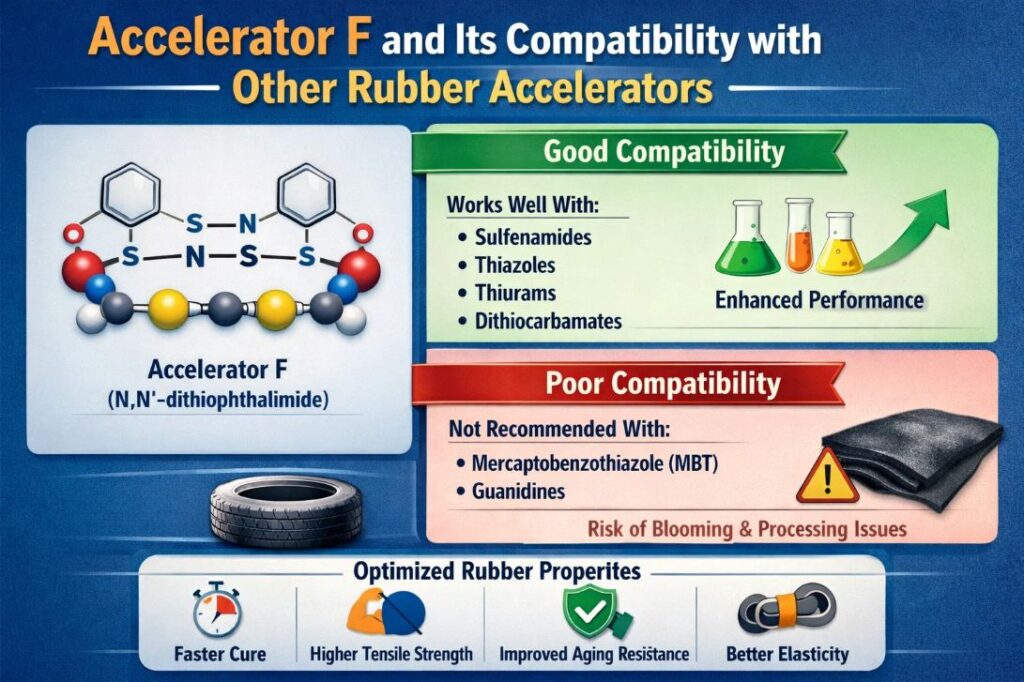
Rubber vulcanization is not controlled by a single accelerator but by complete accelerator systems where primary accelerators, secondary accelerators, retarders, and activators work together. Accelerator F belongs to the guanidine class of secondary accelerators and plays a specific role in strengthening cure systems, particularly those based on thiazole accelerators. However, its effectiveness depends heavily on compatibility with other accelerators.
Understanding compatibility is essential because improper combinations can lead to premature scorch, unstable cure curves, poor mechanical properties, or excessive cure times. This article explains how Accelerator F interacts with major accelerator families, what combinations work best, which combinations should be avoided, and how these interactions influence vulcanization chemistry and final rubber performance.
1) Chemical Identity and Functional Role of Accelerator F
| Parameter | Description |
|---|---|
| Chemical family | Guanidine accelerator |
| Functional type | Secondary accelerator |
| Primary role | Cure activator |
| Cure speed effect | Moderate increase |
| Scorch safety contribution | Low |
| Typical partners | MBT, MBTS |
| Main benefit | Improves crosslink density |
Accelerator F does not initiate vulcanization by itself. It increases the activity of certain primary accelerators by promoting formation of active sulfurating species.
2) Why Compatibility Matters in Accelerator Systems
Rubber compounds require:
• Predictable scorch time
• Controlled cure rate
• Stable torque development
• Target mechanical properties
Compatibility determines whether Accelerator F:
• Enhances cure performance
• Has little effect
• Causes instability
3) Accelerator Families and Their General Behavior
| Accelerator Family | Examples | Cure Speed | Scorch Safety |
|---|---|---|---|
| Thiazoles | MBT, MBTS | Medium | Moderate |
| Sulfenamides | CBS, TBBS | Fast (delayed) | High |
| Thiurams | TMTD | Ultra-fast | Low |
| Dithiocarbamates | ZDEC, ZDBC | Ultra-fast | Very low |
| Guanidines | DPG, Accelerator F | Secondary | Low |
Accelerator F behaves similarly to DPG but has its own performance profile.
4) Compatibility with Thiazole Accelerators
Thiazoles are the most compatible family with Accelerator F.
| Primary Accelerator | Compatibility | Technical Reason | Resulting Effect |
|---|---|---|---|
| MBT | Excellent | Synergistic activation | Faster cure |
| MBTS | Excellent | Improved sulfur transfer | Higher modulus |
| ZMBT | Good | Zinc complex activation | Better uniformity |
Performance Impact
• Shorter optimum cure time
• Higher crosslink density
• Improved tensile strength
• Improved hardness
5) Compatibility with Sulfenamide Accelerators
Sulfenamides already contain delayed activation chemistry.
| Accelerator | Compatibility | Practical Outcome |
|---|---|---|
| CBS | Limited | Minor benefit |
| TBBS | Limited | Usually unnecessary |
Why Limited?
Sulfenamides convert into MBT during curing. Accelerator F offers little additional activation beyond this mechanism.
6) Compatibility with Thiuram Accelerators
| Accelerator | Compatibility | Risk Level |
|---|---|---|
| TMTD | Low | High scorch risk |
Thiurams generate active sulfur rapidly. Adding Accelerator F may:
• Push cure too fast
• Reduce scorch safety
• Cause uneven crosslinking
7) Compatibility with Dithiocarbamate Accelerators
| Accelerator | Compatibility | Reason |
|---|---|---|
| ZDEC | Poor | Already ultra-fast |
| ZDBC | Poor | Over-activation |
No performance benefit is obtained from combining Accelerator F with these.
8) Compatibility with Retarders
| Retarder | Compatibility | Benefit |
|---|---|---|
| PVI | Good | Restores scorch safety |
Useful when Accelerator F is used in warm processing environments.
9) Large Compatibility Matrix
| Accelerator F With → | MBT | MBTS | ZMBT | CBS | TBBS | TMTD | ZDEC | ZDBC | PVI |
|---|---|---|---|---|---|---|---|---|---|
| Compatibility Level | Excellent | Excellent | Good | Limited | Limited | Low | Poor | Poor | Good |
| Cure Speed Change | ↑ | ↑ | ↑ | Slight | Slight | ↑↑ | ↑↑ | ↑↑ | Neutral |
| Scorch Safety | Slight ↓ | Slight ↓ | Slight ↓ | Stable | Stable | Strong ↓ | Very low | Very low | ↑ |
| Typical Use | Recommended | Recommended | Acceptable | Rare | Rare | Avoid | Avoid | Avoid | Recommended |
10) Effect on Cure Curve Parameters
| Parameter | Without Accelerator F | With Accelerator F |
|---|---|---|
| Ts2 (scorch) | Medium | Lower |
| T90 (optimum cure) | Longer | Shorter |
| Maximum torque | Normal | Higher |
| Crosslink density | Moderate | Higher |
11) Influence on Physical Properties
| Property | Effect of Accelerator F |
|---|---|
| Tensile strength | Increase |
| Hardness | Increase |
| Modulus | Increase |
| Elongation | Slight decrease |
| Abrasion resistance | Improve |
| Heat aging | Neutral |
12) Typical Dosage Windows
| System | Accelerator F (phr) |
|---|---|
| MBT-based | 0.5 – 1.0 |
| MBTS-based | 0.4 – 1.0 |
| With PVI | 0.3 – 0.8 |
13) Application-Based Selection
| Application | Recommended Combination |
|---|---|
| Conveyor belts | MBTS + Accelerator F |
| Hoses | MBT + Accelerator F |
| Rubber sheets | MBT + Accelerator F |
| Gaskets | MBTS + Accelerator F |
| Tyres | Usually CBS without F |
14) Common Problems and Corrective Actions
| Problem | Cause | Solution |
|---|---|---|
| Scorch | Too much Accelerator F | Reduce dosage / add PVI |
| Slow cure | Low F dosage | Increase slightly |
| Poor strength | Weak activation | Add Accelerator F |
| Over-cure | Combined with TMTD | Remove F |
15) When NOT to Use Accelerator F
• Latex products
• Ultra-fast cure systems
• Low-nitrosamine formulations
16) Industry Insight
Accelerator F remains valuable mainly in thiazole-based mechanical rubber formulations where improved strength and cure efficiency are required. It is not a universal accelerator and must be selected based on compatibility.
ARPL Product Support
Arihant Reclamation Pvt. Ltd. supplies Accelerator F, MBT, MBTS, CBS, TBBS, TMTD, ZDEC, ZDBC, ZMBT, DPG, PVI, TMQ, TDQ and Zinc Oxide with consistent quality for tyre and non-tyre rubber manufacturers.
📞 +91-8860732624
📧 arihantreclamation@gmail.com
🌐 https://arihantreclamationpvtltd.com/