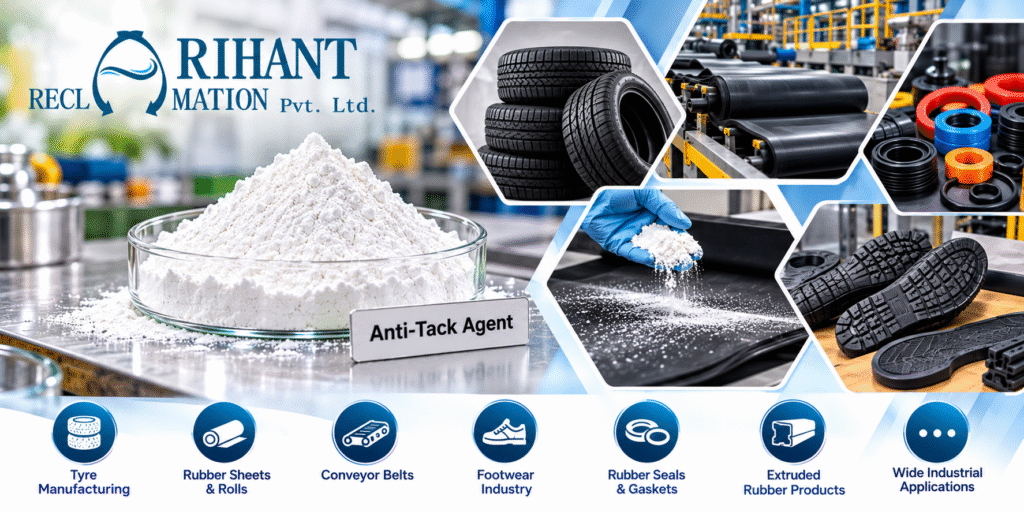
The rubber anti-tack agent market plays an important role in the rubber manufacturing industry by supporting efficient processing, handling, storage and transportation of uncured rubber compounds. Rubber anti-tack agents, also known as anti-adhesive agents or detackifying agents, are used to reduce unwanted sticking between rubber surfaces and help manufacturers handle rubber sheets, strips, extruded profiles and uncured components more efficiently.
As an experienced rubber chemical manufacturer and supplier, Arihant Reclamation Pvt. Ltd. (ARPL) serves industrial rubber manufacturing requirements with a range of rubber accelerators, antioxidants, retarders and other rubber chemicals. Understanding the role of anti-tack agents and related processing chemicals helps buyers make informed decisions about rubber compound quality, production efficiency and material compatibility.
What Are Rubber Anti-Tack Agents?
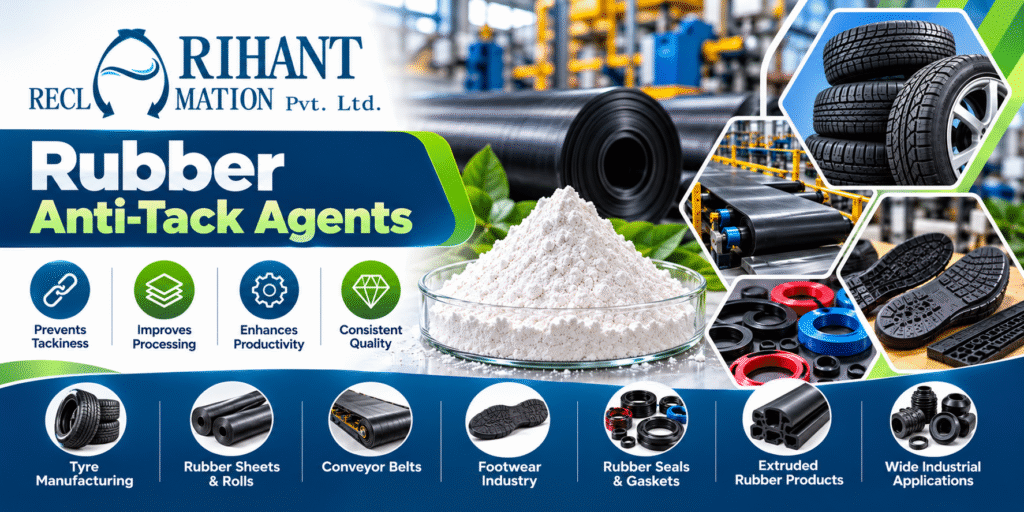
Rubber anti-tack agents are processing materials used to prevent uncured rubber compounds from sticking to themselves or to contacting surfaces during manufacturing, storage and handling. They help maintain separation between rubber layers and make it easier to move, stack, cut and process rubber materials before vulcanization.
Uncured rubber compounds can have a naturally sticky surface, depending on their polymer composition, formulation, temperature and processing conditions. When rubber sheets or strips come into contact under pressure, they may adhere to each other, making separation difficult and potentially disrupting production.
Anti-tack agents help control this problem by creating a suitable surface barrier or modifying surface interactions. Their selection depends on the rubber compound, processing method, downstream operations and required product quality.
Rubber Anti-Tack Agent Market Overview
Demand for rubber anti-tack agents is associated with the manufacturing and processing of tyres, conveyor belts, hoses, molded rubber products, extruded components and other industrial rubber goods. Manufacturers use these materials to improve uncured rubber handling and support efficient production workflows.
The market includes different chemical formulations, physical forms and application methods. Buyers typically evaluate anti-tack performance alongside cost, compatibility, surface cleanliness, application efficiency and the effect on subsequent processing.
| Market Segment | Products or Materials | Main Applications |
|---|---|---|
| Stearate-Based Agents | Calcium stearate, zinc stearate and related stearates | Rubber sheet handling, processing and separation |
| Fatty Acid Esters | Ester-based anti-tack formulations | Tyre manufacturing and industrial rubber processing |
| Fatty Acid Amides | Amide-based processing additives | Selected rubber compounds and surface applications |
| Soap-Based Agents | Soap solutions and water-based formulations | Rubber dipping, sheet separation and handling |
| Silicone-Based Agents | Compatible silicone formulations | Selected release and anti-adhesion applications |
| Powder-Based Products | Suitable mineral powders and formulated blends | Surface treatment of uncured rubber |
| Liquid and Dispersion Products | Water-based or other compatible dispersions | Dipping, spraying and automated application processes |
These categories represent common market segments; not every material is suitable for every rubber compound or process.
Major Applications of Rubber Anti-Tack Agents
Rubber anti-tack agents are used across several manufacturing sectors where uncured rubber must be handled, stored or processed without unwanted adhesion.
1. Tyre Manufacturing
Tyre manufacturing is an important application area because uncured rubber compounds are prepared, shaped, layered and assembled before vulcanization.
Anti-tack agents can help with:
- Separation of uncured rubber sheets and strips
- Handling of selected tyre compound components
- Storage of prepared rubber materials
- Reducing unwanted adhesion during intermediate processing
- Supporting consistent material handling on production lines
The chosen formulation must be compatible with the tyre compound and should not interfere with bonding, vulcanization or final tyre performance.
2. Conveyor Belt Manufacturing
Conveyor belt production involves rubber sheets, layers and components that may require controlled separation during preparation and assembly.
Anti-tack agents can help manufacturers handle uncured rubber materials more efficiently, depending on the compound and manufacturing process.
Related products such as ARPL Accelerator TBBS and ARPL Accelerator MBTS are relevant to rubber vulcanization systems, although they perform a different function from anti-tack agents.
3. Rubber Hoses and Tubes
Rubber hoses and tubes are produced using extrusion, shaping, reinforcement and curing processes. Anti-tack agents may be used where uncured layers or components need to remain separate during handling.
The selection must consider the hose material, reinforcement or bonding requirements, and the intended service conditions.
4. Molded Rubber Products
Manufacturers of molded rubber components may use anti-tack products to support the handling and separation of uncured rubber blanks or prepared compounds.
Typical product categories include:
- Rubber seals and gaskets
- Bushes and mounts
- Industrial rubber components
- Flexible molded parts
- Selected automotive rubber components
Anti-tack agents must be chosen carefully to avoid contamination that could affect mold filling, bonding, surface finish or curing.
5. Extruded Rubber Products
Extruded rubber profiles, strips, tubes and cords may stick together when handled or stored before vulcanization. Appropriate anti-tack treatment can help maintain separation and simplify downstream handling.
The treatment should be compatible with subsequent processing, including joining, coating, bonding and curing.
Benefits of Rubber Anti-Tack Agents
Selecting an appropriate anti-tack agent can provide several manufacturing benefits.
| Benefit | Importance to Manufacturers |
|---|---|
| Reduced Surface Sticking | Helps prevent uncured rubber layers from adhering to each other. |
| Easier Handling | Supports the movement, separation and positioning of rubber materials. |
| Improved Storage Management | Helps maintain separation between prepared rubber sheets or components. |
| Production Efficiency | Can reduce handling difficulties and interruptions caused by sticking. |
| Surface Quality Control | Helps manage unwanted adhesion and related handling defects. |
| Process Consistency | Supports repeatable handling when application conditions are controlled. |
| Reduced Material Damage | Can reduce tearing or deformation during the separation of sticky rubber layers. |
Actual results depend on the agent, application concentration, rubber formulation, processing temperature and production conditions.
Factors Driving the Rubber Anti-Tack Agent Market
The demand for anti-tack agents is influenced by broader developments in rubber manufacturing and processing.
Growth in Rubber Product Manufacturing
Tyres, automotive components, conveyor belts, hoses and industrial rubber products require reliable processing methods. As manufacturers improve production efficiency, anti-tack agents remain relevant to suitable manufacturing operations.
Demand for Efficient Production
Manufacturers seek to minimize unnecessary handling, material damage, production delays and rework. Suitable anti-tack treatments can help address surface adhesion problems in specific processes.
Automation in Rubber Processing
Automated production lines place greater emphasis on consistent material handling and repeatable application. Anti-tack formulations must perform reliably with the selected spraying, dipping or other application equipment.
Product Quality Requirements
Surface contamination, poor separation and inconsistent treatment can affect downstream manufacturing. Buyers increasingly consider application consistency and compatibility when selecting processing aids.
Environmental and Operational Considerations
Manufacturers may evaluate water-based formulations, reduced-residue systems and other alternatives according to their production requirements and environmental obligations. However, the suitability of an alternative must be established through technical evaluation rather than assumed from its formulation alone.
Rubber Anti-Tack Agent Market Trends
Several product and process developments are relevant to anti-tack agent manufacturers, suppliers and industrial buyers.
| Market Trend | What It Means for Buyers |
|---|---|
| Water-Based Formulations | May offer convenient application and easier integration into suitable production processes. |
| Low-Residue Solutions | Help address surface cleanliness and downstream processing requirements. |
| Automated Application | Encourages consistent formulation performance and controlled dosing. |
| Customized Formulations | Allows selection according to the rubber type and manufacturing process. |
| Environmental Compliance | Increases the importance of reviewing chemical composition, wastewater and workplace requirements. |
| Production Efficiency | Encourages manufacturers to evaluate handling performance alongside total operating costs. |
| Quality Consistency | Places emphasis on batch-to-batch performance, technical documentation and supplier reliability. |
These trends are useful considerations for purchasing and formulation decisions; their relevance varies by country, industry and individual manufacturing facility.
How to Select the Right Rubber Anti-Tack Agent
Choosing the right anti-tack agent involves more than comparing prices. A product that works well for one rubber formulation may not provide the same performance in another.
Consider the following factors before purchasing.
1. Rubber Type: Identify whether the compound uses natural rubber, SBR, BR, NBR, EPDM or another elastomer.
2. Processing Method: Determine whether the rubber is calendered, extruded, molded, dipped or handled through another process.
3. Application Method: Check whether the anti-tack agent is supplied as a powder, liquid, dispersion or another form compatible with the production line.
4. Surface Residue: Evaluate whether the treatment leaves deposits that could interfere with bonding, coating, painting or vulcanization.
5. Compatibility: Confirm that the agent does not adversely affect the rubber compound, reinforcement adhesion or final product properties.
6. Application Concentration: Follow the manufacturer’s technical instructions and validate the dosage through suitable trials.
7. Operating Cost: Compare cost per treated unit or per production batch rather than considering only the purchase price per kilogram.
8. Technical Documentation: Request the technical data sheet, safety data sheet, product specification and other relevant documentation.
9. Supply Reliability: Consider product consistency, packaging, delivery requirements and the supplier’s ability to support repeat orders.
Common Problems Associated with Anti-Tack Agents
| Problem | Possible Cause | What to Evaluate |
|---|---|---|
| Rubber layers still stick together | Insufficient coverage or unsuitable formulation | Application uniformity and product compatibility |
| Excessive surface residue | Incorrect concentration or unsuitable agent | Dosage and residue characteristics |
| Poor bonding between rubber layers | Anti-tack residue interfering with adhesion | Downstream bonding requirements and cleaning |
| Uneven surface treatment | Inconsistent spraying, dipping or mixing | Application equipment and process control |
| Production delays | Incompatible treatment or inconsistent performance | Material handling and process conditions |
| Higher processing costs | Excessive consumption or inefficient application | Total treatment cost and application efficiency |
Troubleshooting should be based on production trials and technical evaluation. Increasing the quantity of an anti-tack agent without identifying the cause may create additional problems.
Rubber Anti-Tack Agents and Other Rubber Processing Chemicals
Anti-tack agents have a specific purpose: controlling unwanted adhesion during rubber handling and processing. They should not be confused with accelerators, antioxidants or other rubber compounding chemicals.
These ingredients may be used in the same manufacturing operation, but their functions are different.
| Chemical Category | Main Function | Relevant ARPL Product |
|---|---|---|
| Rubber Accelerators | Control and promote vulcanization in suitable rubber systems | Accelerator MBT |
| Sulfenamide Accelerators | Provide controlled vulcanization and processing characteristics | Accelerator CBS |
| Delayed-Action Accelerators | Support scorch safety and curing performance in suitable formulations | Accelerator TBBS |
| Rubber Antioxidants | Help protect compatible rubber compounds against oxidative aging | Antioxidant TMQ/TDQ |
| Antiozonants | Help protect suitable rubber products against ozone-related degradation | Antioxidant 6PPD |
| Rubber Activators | Support conventional sulfur-vulcanization systems | Zinc Oxide |
| Scorch Retarders | Help delay premature vulcanization during processing | Retarder PVI/CTP |
ARPL’s products serve different rubber compounding functions. They are not presented as substitutes for a dedicated anti-tack agent, and their suitability depends on the particular formulation.
Rubber Anti-Tack Agent Market: Global Demand and Supply Considerations
The rubber anti-tack agent market serves rubber manufacturing operations across multiple regions, including Asia-Pacific, Europe, North America and other industrial markets. Demand is linked to tyre production, industrial rubber manufacturing and the need for reliable processing materials.
However, published market estimates vary significantly because research firms may use different definitions, product categories, geographical coverage and forecast periods. Buyers should consult the methodology and publication date of a specific report before relying on a market-size or growth-rate figure.
For manufacturers and distributors, practical purchasing considerations include:
- Availability of the required formulation and physical form
- Consistency between batches
- Local technical support
- Packaging and transportation requirements
- Compliance with applicable chemical regulations
- Total cost of use
- Reliability of future supply
For current market figures, refer to the relevant research report rather than treating estimates from different publishers as directly comparable.
Why Choose ARPL for Rubber Chemical Requirements?
At Arihant Reclamation Pvt. Ltd. (ARPL), we manufacture and supply a range of rubber chemicals for industrial rubber manufacturing requirements. Our product portfolio includes rubber accelerators, antioxidants, retarders and zinc oxide for applications where these ingredients are suitable.
We understand that rubber manufacturers require products with clear specifications, consistent quality and dependable supply. Our approach focuses on helping buyers identify suitable chemicals for their rubber compounding requirements.
Our product range includes:
- Rubber Accelerators
- Accelerator MBTS
- Accelerator ZDEC
- Accelerator ZDBC
- Antioxidant TMQ/TDQ
- Zinc Oxide
- Complete Rubber Chemical Product Range
For anti-tack agent enquiries specifically, buyers should confirm the required product and its availability. Our listed rubber chemicals support other functions in rubber processing and should be selected according to the application.
Contact ARPL for Rubber Chemical Supply
If you are a rubber manufacturer, industrial buyer, distributor or procurement professional looking for rubber chemicals, contact our team to discuss your product specifications and supply requirements.
Arihant Reclamation Pvt. Ltd. (ARPL)
- Phone: +91-8860-732-624 / +91-9625-671-802
- Email: arihantreclamationpvtltd@gmail.com
- Address: 40.3 km Milestone, GT Road, Bahalgarh, Sonepat, Haryana 131021, India
- Website: arihantreclamationpvtltd.com
- Products: Explore Our Rubber Chemicals
We welcome enquiries from domestic and international customers seeking suitable rubber chemicals for their manufacturing operations.
Frequently Asked Questions
What is a rubber anti-tack agent?
A rubber anti-tack agent is a processing material used to reduce unwanted sticking between uncured rubber surfaces or between rubber and contacting surfaces during manufacturing and storage.
What are rubber anti-tack agents used for?
They are used in suitable processes involving tyre compounds, rubber sheets, extruded profiles, conveyor belt materials, hoses and other uncured rubber components.
Which types of rubber anti-tack agents are available?
Common categories include stearates, fatty acid esters, fatty acid amides, soap-based formulations, silicone-based products and other specialized formulations.
How do I choose a rubber anti-tack agent?
Consider the rubber polymer, manufacturing process, application method, surface residue, downstream bonding requirements, compatibility and total cost of use.
Are anti-tack agents the same as rubber accelerators?
No. Anti-tack agents help prevent unwanted adhesion during handling, while rubber accelerators promote or control vulcanization in suitable rubber formulations.
Does ARPL supply rubber anti-tack agents?
ARPL’s listed portfolio includes rubber accelerators, antioxidants, retarders and zinc oxide. Please contact our team to confirm availability of a specific anti-tack agent. The listed products should not be assumed to be dedicated anti-tack agents.