Complete Technical Guide for Rubber Compounders and Manufacturers
The rubber manufacturing industry relies heavily on specialized chemicals to achieve the desired balance of processing characteristics, curing efficiency, mechanical strength, durability, and long-term performance. Among these chemicals, Accelerator F has earned a reputation as an important secondary accelerator and activator used in sulfur-vulcanized rubber compounds. While primary accelerators such as MBT, MBTS, CBS, TBBS, and TMTD often receive most of the attention in rubber formulations, Accelerator F plays a crucial supporting role that can significantly improve vulcanization efficiency and overall compound performance.
Modern rubber manufacturers face increasing pressure from customers and OEMs to deliver products that offer superior durability, longer service life, improved resistance to heat and aging, and consistent quality from batch to batch. Achieving these goals requires more than simply selecting high-quality rubber polymers. It requires careful optimization of the entire vulcanization system, including sulfur, activators, accelerators, antioxidants, and processing aids. This is where Accelerator F becomes particularly valuable.
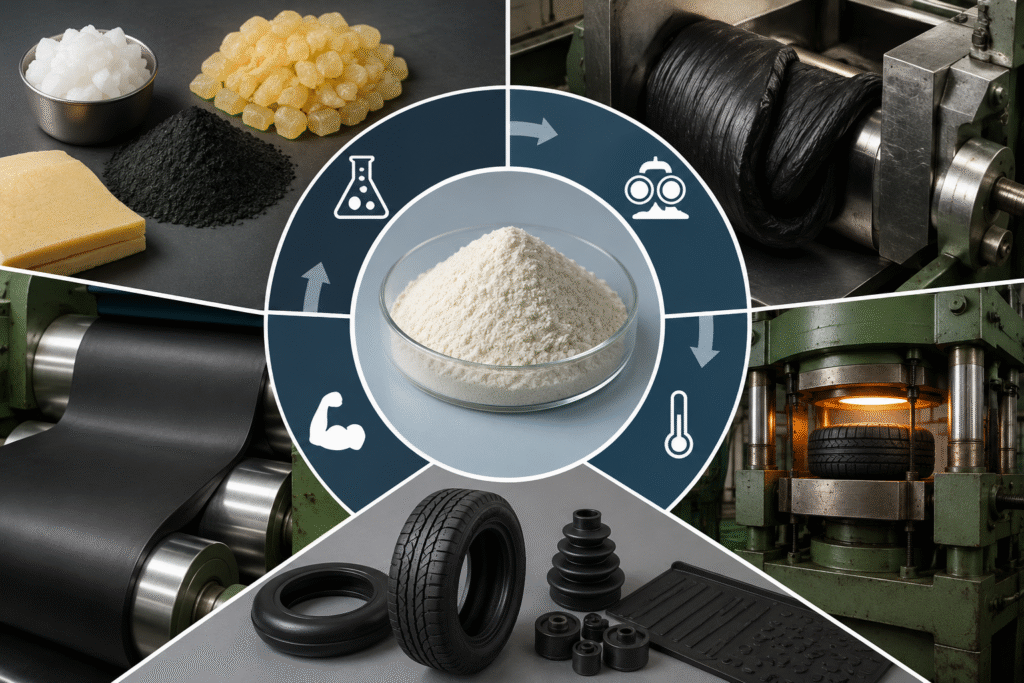
Accelerator F is widely used across various sectors of the rubber industry, including automotive components, industrial rubber products, conveyor belts, footwear, molded goods, rubber sheets, hoses, seals, gaskets, and engineering rubber products. Manufacturers often incorporate Accelerator F into formulations to improve cure characteristics, strengthen physical properties, and create more stable production processes.
Understanding how Accelerator F works, where it is used, and why manufacturers continue to rely on it can help compounders make better formulation decisions and improve production efficiency.
What Is Accelerator F?
Accelerator F is generally classified as a secondary accelerator and accelerator activator used in sulfur curing systems. Unlike primary accelerators that directly control the speed of vulcanization, Accelerator F is designed to support and enhance the activity of other accelerators present in the formulation.
Its primary function is to increase the effectiveness of the vulcanization system, allowing sulfur cross-linking reactions to proceed more efficiently. The result is improved cure behavior, better physical properties, and more reliable production outcomes.
Many rubber compounders consider Accelerator F a performance-enhancing additive because it contributes to stronger cross-link formation while helping maintain processing stability. Even when used at relatively low dosage levels, it can have a measurable impact on the final quality of rubber products.
Why Is Accelerator F Important in Modern Rubber Manufacturing?
The performance requirements for today’s rubber products are far more demanding than they were decades ago. Automotive manufacturers require rubber components capable of withstanding extreme temperatures, continuous vibration, oils, chemicals, and environmental exposure. Industrial customers demand longer-lasting conveyor belts, seals, hoses, and molded products. Export markets often require strict compliance with international quality standards.
To meet these expectations, manufacturers must optimize every aspect of the rubber formulation.
Accelerator F contributes to this optimization by improving the efficiency of the curing process. Better cure efficiency often translates into improved tensile strength, better tear resistance, increased elasticity, enhanced abrasion resistance, and improved durability. These improvements directly affect product performance and customer satisfaction.
In many manufacturing facilities, reducing rejection rates and achieving consistent quality are top priorities. Accelerator F helps achieve these objectives by supporting uniform vulcanization throughout the rubber compound.
How Accelerator F Works During Vulcanization
The vulcanization process transforms raw rubber into a durable elastic material through the formation of sulfur cross-links between polymer chains.
Without accelerators, sulfur vulcanization proceeds very slowly and is not practical for commercial manufacturing. Primary accelerators speed up this reaction significantly. Accelerator F works alongside these primary accelerators to further improve the efficiency of cross-link formation.
As vulcanization progresses, Accelerator F helps optimize the chemical reactions occurring within the compound. This can lead to improved cure characteristics and stronger network formation within the rubber matrix.
The resulting vulcanized rubber often exhibits better mechanical performance and more consistent properties throughout the finished product.
Key Functions of Accelerator F
Function
Benefit to Manufacturer
Accelerator Enhancement
Improves efficiency of primary accelerators
Cure Optimization
Helps achieve balanced vulcanization
Physical Property Improvement
Enhances tensile and tear strength
Processing Stability
Improves consistency during production
Cross-Link Development
Supports stronger vulcanized structures
Production Efficiency
Helps reduce processing variability
Quality Consistency
Improves batch-to-batch performance
Formulation Flexibility
Compatible with multiple accelerator systems
Major Benefits of Using Accelerator F
Improved Tensile Strength
Rubber products must withstand stretching forces during service. Improved vulcanization efficiency often results in stronger polymer networks, contributing to higher tensile strength and better product durability.
Better Tear Resistance
Products such as conveyor belts, seals, footwear soles, and industrial components are subjected to mechanical stresses that can cause tearing. Accelerator F can contribute to improved tear resistance by promoting more effective cross-link formation.
Enhanced Abrasion Resistance
Abrasion resistance is particularly important for products exposed to friction and wear. Better vulcanization often translates into improved resistance to surface degradation and longer product life.
Improved Elastic Recovery
Many rubber applications depend on the material’s ability to deform and return to its original shape. Accelerator F can help maintain desirable elastic properties by supporting optimal cure development.
Consistent Manufacturing Results
Manufacturers value consistency because it reduces waste, lowers rejection rates, and improves customer satisfaction. Accelerator F helps support stable cure behavior across production batches.
Common Rubber Products That Use Accelerator F
Industry
Products
Automotive
Bushings, seals, gaskets, mounts
Tire Industry
Various tire compounds
Industrial Rubber
Conveyor belts, sheets, rollers
Footwear
Shoe soles and industrial footwear
Construction
Expansion joints and sealing systems
Engineering Rubber
Custom molded rubber products
Agricultural Equipment
Rubber components and seals
Mining Industry
Wear-resistant rubber parts
Oil & Gas
Specialized sealing products
General Manufacturing
Rubber molded goods
Accelerator F Compatibility with Other Accelerators
One of the strongest advantages of Accelerator F is its compatibility with many commonly used accelerator systems.
Accelerator Systems Commonly Used with Accelerator F
Primary Accelerator
Compatibility
MBT
Excellent
MBTS
Excellent
CBS
Excellent
TBBS
Excellent
TMTD
Good
DPG
Good
DCBS
Good
ZDMC
Moderate
This flexibility allows compounders to tailor cure systems according to specific processing requirements and end-use applications.
Accelerator F vs DPG
Property
Accelerator F
DPG
Main Role
Secondary Accelerator
Secondary Accelerator
Cure Enhancement
High
Moderate
Compatibility
Excellent
Excellent
Processing Stability
High
Good
Physical Property Improvement
Strong
Moderate
Industrial Usage
Broad
Broad
Many manufacturers use both materials within carefully balanced formulations to achieve specific performance objectives.
Factors to Consider When Using Accelerator F
Several factors influence the effectiveness of Accelerator F:
Rubber Type
Performance may vary depending on whether the compound is based on Natural Rubber (NR), Styrene Butadiene Rubber (SBR), Nitrile Rubber (NBR), EPDM, or other elastomers.
Sulfur Level
The sulfur concentration affects cross-link density and overall vulcanization behavior.
Processing Temperature
Mixing and curing temperatures influence accelerator activity and cure performance.
Accelerator Package
The choice of primary accelerators significantly affects how Accelerator F performs within the formulation.
End-Use Requirements
Product requirements such as heat resistance, flexibility, abrasion resistance, and durability should guide formulation decisions.
Why Rubber Manufacturers Continue to Use Accelerator F
Despite advances in rubber chemistry and the introduction of newer accelerator technologies, Accelerator F remains widely used because it offers a proven combination of effectiveness, reliability, compatibility, and cost-efficiency.
Manufacturers appreciate its ability to support better vulcanization performance without requiring major changes to existing formulations. This makes it particularly attractive for companies seeking incremental improvements in product quality and manufacturing consistency.
In highly competitive industries where production efficiency and product reliability are critical, even small improvements in cure performance can generate substantial operational benefits.
Choosing a Reliable Accelerator F Supplier
The quality of Accelerator F can directly influence vulcanization performance and finished product quality. Manufacturers should work with suppliers capable of providing:
Consistent product quality
Technical support
Competitive pricing
Bulk supply capabilities
Export documentation
Reliable delivery schedules
Product traceability
Quality certifications
Partnering with an experienced supplier reduces procurement risks and helps ensure consistent manufacturing performance.
Buy Accelerator F from Arihant Reclamation Pvt. Ltd.
Arihant Reclamation Pvt. Ltd. is a trusted supplier, exporter, and manufacturer-focused partner for high-quality rubber chemicals serving customers across India and global markets.
We offer a complete range of rubber chemicals including:
Accelerator F
MBT
MBTS
CBS
TMTD
DPG
DCBS
TMQ
6PPD
Zinc Oxide
Rubber Antioxidants
Rubber Accelerators
Specialty Rubber Additives
Whether you are an MSME manufacturer, OEM supplier, tire manufacturer, footwear producer, rubber compounder, or industrial processor, our team can help you source high-quality rubber chemicals that meet your production and performance requirements.
Contact us today for bulk orders, export inquiries, technical support, product specifications, and customized rubber chemical solutions.
Frequently Asked Questions
Is Accelerator F a primary accelerator?
No. Accelerator F is generally used as a secondary accelerator and activator that enhances the performance of primary accelerators.
Which accelerators are compatible with Accelerator F?
Accelerator F is commonly used with MBT, MBTS, CBS, TBBS, TMTD, DPG, and other sulfur vulcanization systems.
Which industries use Accelerator F?
Automotive, tire manufacturing, footwear, industrial rubber products, engineering rubber components, construction materials, and various molded rubber industries use Accelerator F.
What are the main benefits of Accelerator F?
Improved cure efficiency, enhanced tensile strength, better tear resistance, improved processing stability, and more consistent product quality.
Where can I buy Accelerator F in bulk?
Arihant Reclamation Pvt. Ltd. supplies Accelerator F and a complete range of rubber chemicals to manufacturers across India and international markets.