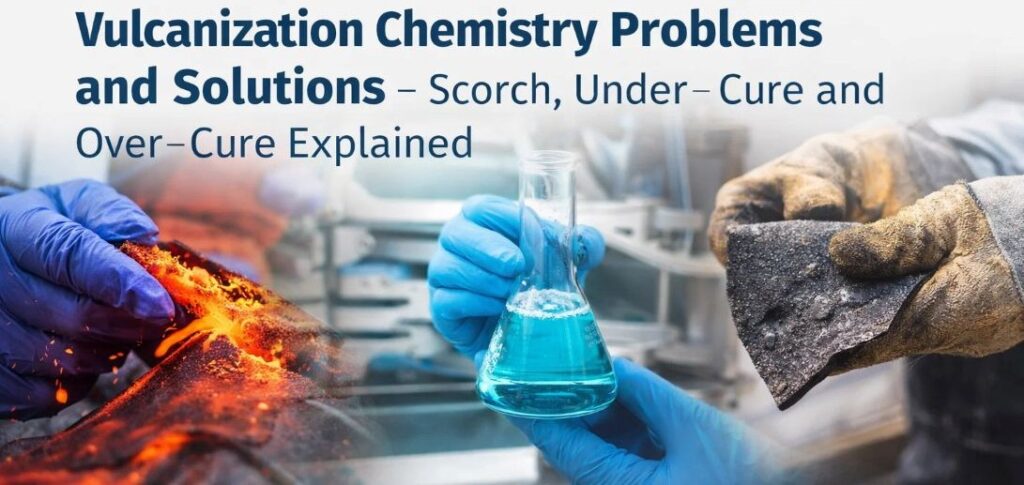
Vulcanization chemistry is the most critical stage in rubber manufacturing, directly determining the strength, elasticity, durability, and service life of rubber products. Even small deviations in curing conditions or chemical balance can lead to serious problems such as scorch, under-cure, or over-cure. These issues not only affect physical properties but also increase scrap rates, downtime, and production costs.
Understanding vulcanization chemistry problems and their solutions helps manufacturers maintain consistent quality in tyres, hoses, belts, seals, gaskets, footwear, and industrial rubber components. This guide explains the root causes of common curing problems, how they affect rubber performance, and how proper control of accelerators, activators, temperature, and time can prevent them.
Overview of Vulcanization Chemistry
Vulcanization is a chemical process where rubber polymer chains are crosslinked using sulfur or other curing systems in the presence of accelerators and activators. The quality of vulcanization depends on:
- Type and dosage of accelerators
- Sulfur level and crosslink structure
- Presence of activators like Zinc Oxide and stearic acid
- Processing temperature and curing time
- Scorch safety and cure control
When these factors are not balanced correctly, curing problems arise.
Problem 1: Scorch in Rubber Compounds
What Is Scorch?
Scorch refers to premature vulcanization that occurs during mixing, milling, extrusion, or calendaring—before the compound reaches the mold or press. Once scorch begins, rubber loses flow and becomes difficult or impossible to process.
Causes of Scorch
- Excessive processing temperature
- Use of fast or ultra-fast accelerators
- Insufficient scorch safety in the formulation
- Long mixing or storage time at elevated temperatures
- High shear during processing
Impact of Scorch on Rubber Products
- Poor surface finish
- Incomplete mold filling
- Weak bonding between layers
- Increased scrap and downtime
Solutions to Prevent Scorch
- Use delayed-action accelerators such as CBS or TBBS
- Add a pre-vulcanization inhibitor (PVI) to improve scorch safety
- Reduce processing temperature where possible
- Optimize accelerator dosage
- Minimize compound storage time before curing
Problem 2: Under-Cure in Vulcanization
What Is Under-Cure?
Under-cure occurs when rubber does not receive sufficient heat, time, or chemical activation to complete crosslink formation. The result is a rubber product that feels soft, weak, or tacky.
Causes of Under-Cure
- Insufficient curing time or temperature
- Low accelerator or sulfur dosage
- Poor accelerator activation
- Incorrect balance between primary and secondary accelerators
- Inadequate mixing and dispersion
Effects of Under-Cure
- Low tensile strength and modulus
- Poor abrasion resistance
- High compression set
- Reduced heat and aging resistance
- Short service life
Solutions for Under-Cure
- Increase curing time or temperature within safe limits
- Optimize accelerator system (e.g., add secondary accelerators)
- Ensure proper dispersion of chemicals
- Verify Zinc Oxide and activator levels
- Use rheometer testing to confirm optimum cure time
Problem 3: Over-Cure in Rubber Compounds
What Is Over-Cure?
Over-cure happens when rubber is exposed to excessive heat or curing time, causing crosslinks to break down or rearrange. This phenomenon is also known as reversion in certain rubber types.
Causes of Over-Cure
- Excessive curing temperature
- Over-long curing cycles
- High sulfur levels
- Overuse of fast accelerators
- Poor temperature control in presses
Effects of Over-Cure
- Reduced tensile strength
- Loss of elasticity
- Increased brittleness
- Poor fatigue resistance
- Cracking during service
Solutions for Over-Cure
- Reduce curing temperature or time
- Balance sulfur and accelerator levels
- Use accelerator systems with better cure stability
- Avoid excessive use of ultra-fast accelerators
- Monitor curing curves using MDR or ODR testing
Comparison of Vulcanization Problems
| Issue | Scorch | Under-Cure | Over-Cure |
|---|---|---|---|
| When It Occurs | Before curing | During curing | After excessive curing |
| Main Cause | Premature activation | Insufficient cure energy | Excessive cure energy |
| Processing Impact | Severe | Moderate | Low |
| Physical Properties | Poor flow | Weak rubber | Brittle rubber |
| Primary Risk | Scrap | Performance failure | Aging failure |
Role of Accelerators in Preventing Cure Problems
Accelerator selection plays a major role in avoiding vulcanization defects:
| Accelerator Type | Effect on Cure | Risk Control |
|---|---|---|
| Thiazoles (MBT, MBTS) | Moderate cure speed | Balanced systems |
| Sulfenamides (CBS, TBBS) | Delayed action | Excellent scorch safety |
| Thiurams (TMTD) | Very fast cure | Risk of scorch & over-cure |
| Retarders (PVI) | Delays cure onset | Prevents scorch |
Correct accelerator combinations help achieve a wide processing window while maintaining strong final properties.
Importance of Testing in Vulcanization Chemistry
Routine testing helps detect and prevent curing problems before mass production:
- Rheometer testing for cure curve analysis
- Mooney scorch testing for scorch safety
- Tensile and elongation testing
- Heat aging and compression set tests
These tests allow manufacturers to fine-tune formulations and avoid costly failures.
Practical Approach to Solving Vulcanization Issues
A systematic approach includes:
- Reviewing cure curves
- Adjusting accelerator systems gradually
- Controlling temperature and pressure precisely
- Ensuring consistent raw material quality
- Monitoring processing conditions continuously
Industry Perspective
Scorch, under-cure, and over-cure are not random problems—they are direct outcomes of vulcanization chemistry imbalance. Manufacturers who understand the chemistry behind curing can prevent defects, improve productivity, and deliver reliable rubber products across demanding applications.
ARPL Product Support
Arihant Reclamation Pvt. Ltd. supplies a complete range of rubber accelerators, retarders, and antioxidants used in vulcanization chemistry, including MBT, MBTS, CBS, TBBS, TMTD, ZDEC, ZDBC, ZMBT, PVI, DPG, TMQ, TDQ, and Zinc Oxide. These products support stable curing, improved scorch safety, and consistent performance for tyre and non-tyre rubber manufacturers.
📞 +91-8860732624
📧 arihantreclamation@gmail.com
🌐 https://arihantreclamationpvtltd.com/