Rubber Chemicals Full Forms help manufacturers, buyers, and industry professionals understand the different chemicals used in rubber compounding and processing. Rubber accelerators, antioxidants, retarders, zinc oxide, and other specialty additives each perform specific functions, from controlling vulcanization and improving curing efficiency to protecting rubber against heat, oxidation, ozone, and aging. Understanding their full forms, chemical names, uses, and applications makes it easier to select the right rubber chemicals for tyres, automotive components, industrial rubber products, footwear, hoses, belts, seals, and other high-performance applications.
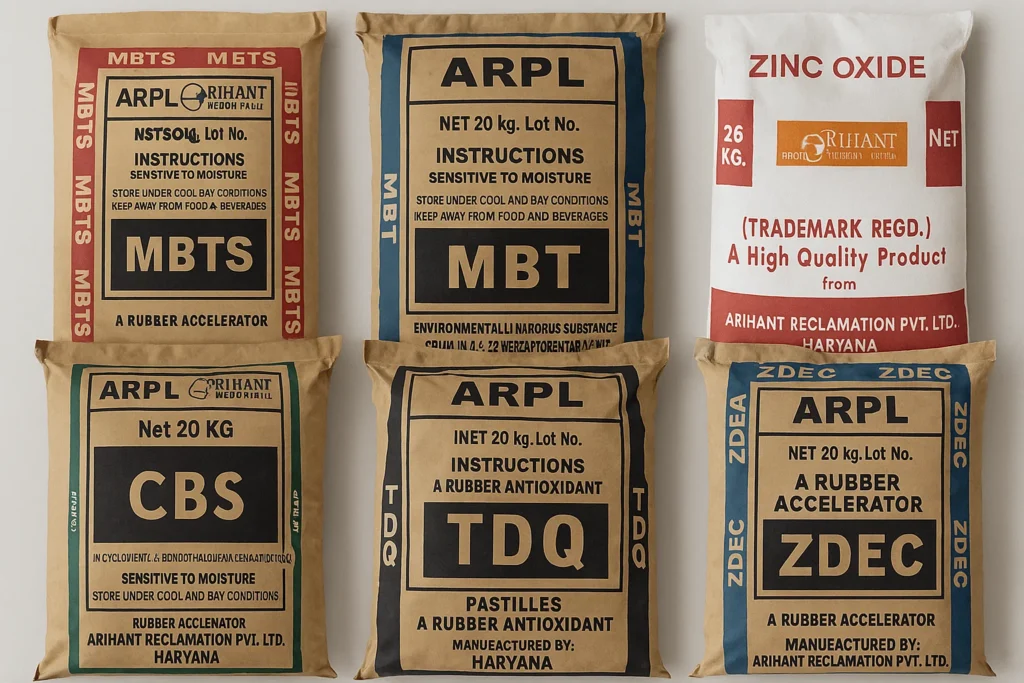
For manufacturers, buyers, engineers, and rubber processors, understanding the full form, chemical name, function, and uses of rubber chemicals is important when selecting the right material for a formulation. Common industry searches include MBT full form, MBTS full form, CBS full form, TMTD full form, TDQ full form, 6PPD full form, PVI full form, and many others.
This guide explains the major rubber chemicals supplied by ARPL, including their full forms, applications, and roles in rubber compounding.
Rubber Accelerators Full Forms and Uses
Rubber accelerators increase the rate and efficiency of vulcanization. They work with sulfur and activators such as zinc oxide and stearic acid to produce the desired curing characteristics.
| Product | Full Form / Chemical Name | Main Function |
|---|---|---|
| MBT | 2-Mercaptobenzothiazole | Primary accelerator |
| MBTS | Dibenzothiazole Disulfide | Delayed-action accelerator |
| CBS | N-Cyclohexyl-2-benzothiazolesulfenamide | Delayed-action accelerator |
| TMTD | Tetramethylthiuram Disulfide | Ultra-fast accelerator |
| ZDEC | Zinc Diethyl Dithiocarbamate | Fast accelerator |
| ZDBC | Zinc Dibutyldithiocarbamate | Fast accelerator |
| ZMBT | Zinc 2-Mercaptobenzothiazole | Accelerator and activator |
| TBBS | N-tert-Butyl-2-benzothiazolesulfenamide | Delayed-action accelerator |
| MOR | 2-Morpholinothiobenzothiazole | Rubber accelerator |
| DCBS | N,N-Dicyclohexyl-2-benzothiazolesulfenamide | Delayed-action accelerator |
| DPTT | Dipentamethylene Thiuram Tetrasulfide | Rubber accelerator |
| DTDM | 4,4′-Dithiodimorpholine | Sulfur donor |
| DPG | Diphenylguanidine | Secondary accelerator |
| TMTM | Tetramethylthiuram Monosulfide | Fast accelerator |
| ZDMC | Zinc Dimethyldithiocarbamate | Ultra-fast accelerator |
| NA22 / ETU | Ethylene Thiourea | Accelerator, especially for polychloroprene |
| PVI | N-(Cyclohexylthio)phthalimide | Vulcanization retarder |
MBT Full Form and Uses
MBT stands for 2-Mercaptobenzothiazole. It is a widely used primary rubber accelerator for sulfur vulcanization.
MBT provides relatively fast curing and is used in natural rubber and several synthetic rubber formulations. It can help improve processing efficiency and the physical properties of cured rubber.
Common applications include tyres, footwear, belts, hoses, molded rubber products, seals, and general industrial rubber goods.
MBTS Full Form and Uses
MBTS stands for Dibenzothiazole Disulfide. It is a delayed-action accelerator commonly used where a controlled scorch time and reliable curing profile are required.
MBTS is suitable for tyre compounds, rubber belts, hoses, footwear, cables, and other industrial rubber applications.
CBS Full Form and Uses
CBS stands for N-Cyclohexyl-2-benzothiazolesulfenamide. It is a highly important delayed-action rubber accelerator.
CBS provides good scorch safety combined with efficient curing, making it widely used in tyre manufacturing and other rubber products requiring controlled processing.
TMTD Full Form and Uses
TMTD stands for Tetramethylthiuram Disulfide. It is a fast-acting accelerator and can also function as a sulfur donor in suitable formulations.
TMTD is used in rubber products requiring rapid vulcanization and is found in applications such as tyres, hoses, belts, footwear, and molded rubber components.
ZDEC Full Form and Uses
ZDEC stands for Zinc Diethyl Dithiocarbamate. It is a fast rubber accelerator that can provide rapid curing and is particularly useful in latex and certain dry-rubber formulations.
ZDBC Full Form and Uses
ZDBC stands for Zinc Dibutyldithiocarbamate. It is a highly active accelerator used where rapid vulcanization is required.
It finds applications in rubber compounds, latex products, industrial rubber goods, and other formulations requiring efficient curing.
ZMBT Full Form and Uses
ZMBT stands for Zinc 2-Mercaptobenzothiazole. It is a zinc salt of MBT and is used as an accelerator in rubber vulcanization.
Its applications include tyres, hoses, belts, molded rubber goods, and other industrial rubber products.
TBBS Full Form and Uses
TBBS stands for N-tert-Butyl-2-benzothiazolesulfenamide. It is a delayed-action accelerator offering good scorch safety and curing performance.
TBBS is especially important in tyre compounds and high-performance rubber formulations.
MOR Full Form and Uses
MOR is commonly used as the designation for 2-Morpholinothiobenzothiazole. It functions as a rubber vulcanization accelerator and is used in selected rubber formulations to achieve controlled curing characteristics.
DCBS Full Form and Uses
DCBS stands for N,N-Dicyclohexyl-2-benzothiazolesulfenamide. It is a delayed-action accelerator known for good scorch safety.
It can be used in demanding rubber formulations where controlled processing and curing are important.
DPTT Full Form and Uses
DPTT stands for Dipentamethylene Thiuram Tetrasulfide. It is a thiuram-type rubber accelerator and sulfur donor used in specialized vulcanization systems.
DTDM Full Form and Uses
DTDM stands for 4,4′-Dithiodimorpholine. It is primarily used as a sulfur donor in rubber compounding and can help provide controlled vulcanization and heat-aging performance.
DPG Full Form and Uses
DPG stands for Diphenylguanidine. It is generally used as a secondary accelerator or activator in rubber formulations.
DPG is often combined with other accelerator systems to improve curing efficiency and achieve the desired vulcanization characteristics.
TMTM Full Form and Uses
TMTM stands for Tetramethylthiuram Monosulfide. It is a fast accelerator used in rubber compounding where rapid curing characteristics are required.
ZDMC Full Form and Uses
ZDMC stands for Zinc Dimethyldithiocarbamate. It is a highly active accelerator used for fast vulcanization, including selected latex and rubber applications.
NA22 / ETU Full Form and Uses
ETU stands for Ethylene Thiourea. NA-22 is a commonly used designation for this accelerator.
It is particularly associated with polychloroprene and certain specialty rubber systems where effective vulcanization is required.
Accelerator F
Accelerator F is an industry product designation used for specific rubber accelerator formulations. Its exact chemical identity and specification should be confirmed against the manufacturer’s technical data sheet before formulation or procurement.
Rubber Antioxidants Full Forms and Uses
Antioxidants protect rubber from degradation caused by oxygen, heat, ozone, and other environmental factors. They are essential for extending the service life of tyres and industrial rubber products.
6PPD Full Form and Uses
6PPD stands for N-(1,3-Dimethylbutyl)-N’-phenyl-p-phenylenediamine.
It is a widely used antidegradant and ozone-protective agent in tyre and rubber manufacturing. 6PPD helps protect rubber compounds from ozone cracking and oxidative degradation.
It is extensively used in tyres, automotive rubber components, hoses, belts, and other products exposed to demanding environmental conditions.
TMQ Full Form and Uses
TMQ stands for 2,2,4-Trimethyl-1,2-dihydroquinoline.
TMQ is an important rubber antioxidant used to protect rubber against heat and oxidative aging. It is widely used in tyre compounds and industrial rubber products.
TDQ Full Form and Uses
TDQ is commonly associated with polymerized 2,2,4-trimethyl-1,2-dihydroquinoline antioxidant systems. It is used to improve resistance against oxidative and thermal aging in rubber compounds.
TDQ-type antioxidant materials are relevant to tyres and other rubber products requiring improved aging resistance.
Wingstay L
Wingstay L is a commercial rubber antioxidant grade used for protecting rubber compounds against oxidative and thermal degradation. Commercial product specifications can vary, so buyers should verify the applicable technical data sheet for exact composition and performance characteristics.
MBI Full Form and Uses
MBI stands for 2-Mercaptobenzimidazole. It is used as an antioxidant and antidegradant in selected rubber formulations.
MBI can help protect rubber against aging and oxidation and is used in specialty rubber applications.
IPPD Full Form and Uses
IPPD stands for N-Isopropyl-N’-phenyl-p-phenylenediamine. It is an antidegradant used to provide protection against ozone and oxidative aging in rubber compounds.
Antioxidant 445
Antioxidant 445 is an industrial antioxidant designation used in polymer and rubber applications. It is selected where protection against thermal and oxidative degradation is required. The exact grade and specification should be confirmed with the supplier before application.
Antioxidant SP Oil
SP Oil is a commercial antioxidant product designation used in rubber compounding. It is used in selected formulations to provide protection against degradation and improve the durability of rubber products.
Zinc Oxide 99.5% in Rubber Compounding
Zinc oxide 99.5% is an important rubber compounding ingredient and vulcanization activator.
It works together with stearic acid and rubber accelerators to improve sulfur curing efficiency. High-purity zinc oxide is widely used in tyres, hoses, belts, footwear, seals, gaskets, and other industrial rubber products.
Its major functions include:
- Activating vulcanization
- Improving curing efficiency
- Supporting accelerator performance
- Enhancing mechanical properties
- Improving heat and aging resistance
- Contributing to consistent rubber processing
PVI Full Form and Uses
PVI stands for N-(Cyclohexylthio)phthalimide. It is commonly used as a pre-vulcanization inhibitor or rubber curing retarder.
PVI helps improve scorch safety during processing. This is particularly useful when manufacturers need additional processing time before vulcanization begins.
Why Rubber Manufacturers Use Accelerators and Antioxidants
A modern rubber formulation often requires a carefully balanced combination of accelerators, antioxidants, activators, sulfur donors, and retarders.
Accelerators control the speed and characteristics of vulcanization, while antioxidants protect the finished rubber against aging. Zinc oxide supports the curing system, and PVI can provide additional scorch protection.
The correct combination can help manufacturers achieve:
- Consistent curing
- Better tensile strength
- Improved abrasion resistance
- Enhanced heat resistance
- Better aging performance
- Improved processing safety
- Longer product life
- Reliable production quality
Applications of Rubber Chemicals
These chemicals are used across numerous industries, including:
- Tyre manufacturing
- Automotive rubber components
- Conveyor belts
- Industrial hoses
- Rubber sheets
- Footwear
- Seals and gaskets
- Cables and wires
- Vibration-control products
- Molded rubber components
- Engineering rubber products
- Latex products
Choosing the Right Rubber Chemical Supplier
When sourcing rubber accelerators, antioxidants, zinc oxide, or retarders, manufacturers should consider product purity, batch consistency, technical specifications, packaging, supply reliability, documentation, and application support.
A dependable supplier should be able to provide consistent material quality for both domestic manufacturing and bulk export requirements.
Partner with ARPL for Rubber Chemicals
If you are looking for a reliable rubber chemical company in India, ARPL offers a broad portfolio of rubber accelerators, antioxidants, zinc oxide, and specialty rubber chemicals for industrial applications.
ARPL supplies products including MBT, MBTS, CBS, TMTD, ZDEC, ZDBC, ZMBT, TBBS, MOR, DCBS, DPTT, DTDM, DPG, TMTM, ZDMC, PVI, ETU, zinc oxide 99.5%, 6PPD, TMQ/TDQ, Wingstay L, MBI, IPPD, Antioxidant SP Oil, and Antioxidant 445.
Whether you need rubber chemicals for tyre manufacturing, industrial rubber products, automotive components, or other compounding applications, ARPL can support bulk sourcing requirements with product-focused solutions.
For bulk orders and export enquiries:
📞 +91-8860732624
📧 arihantreclamation@gmail.com
🌐 arihantreclamationpvtltd.com
Contact ARPL today for rubber accelerator, antioxidant, zinc oxide, retarder, and rubber compounding chemical requirements.
Frequently Asked Questions
What is MBT full form in rubber?
MBT stands for 2-Mercaptobenzothiazole and is widely used as a primary rubber vulcanization accelerator.
What is MBTS full form?
MBTS stands for Dibenzothiazole Disulfide, a delayed-action accelerator used in various rubber compounds.
What is CBS full form in rubber?
CBS stands for N-Cyclohexyl-2-benzothiazolesulfenamide, a delayed-action rubber accelerator widely used in tyre manufacturing.
What is TMTD full form?
TMTD stands for Tetramethylthiuram Disulfide, a fast accelerator and sulfur donor used in rubber vulcanization.
What is TDQ full form?
TDQ refers to polymerized 2,2,4-trimethyl-1,2-dihydroquinoline antioxidant systems, used for protection against oxidative and thermal aging.
What is 6PPD full form?
6PPD stands for N-(1,3-Dimethylbutyl)-N’-phenyl-p-phenylenediamine, an important rubber antidegradant and ozone-protective chemical.
What is PVI full form?
PVI stands for N-(Cyclohexylthio)phthalimide and is used as a pre-vulcanization inhibitor or rubber curing retarder.
What is zinc oxide used for in rubber?
Zinc oxide acts primarily as a vulcanization activator and supports efficient curing while contributing to the performance of finished rubber products.
What are rubber accelerators used for?
Rubber accelerators increase the efficiency and control of vulcanization, helping manufacturers achieve the required curing speed and physical properties.
What are rubber antioxidants used for?
Rubber antioxidants protect rubber from oxidative, thermal, and environmental degradation, helping improve durability and service life.
Get the right rubber chemicals for your formulation with ARPL. Call +91-8860732624 for bulk requirements and enquiries.