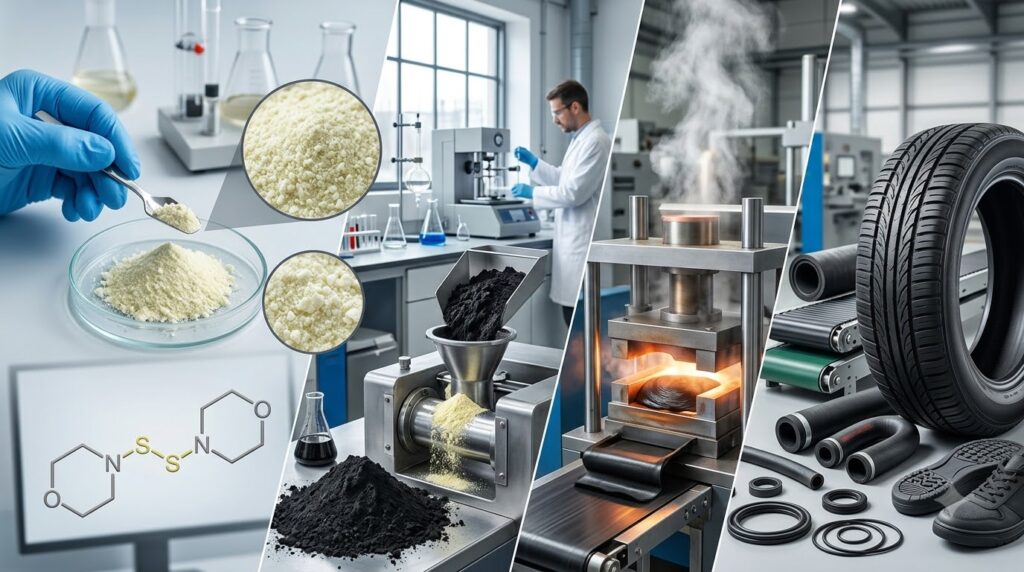
Accelerator DTDM is an important sulfur-donor and vulcanization accelerator used in rubber compounding to improve curing efficiency, processing performance, and the final properties of vulcanized rubber. It is widely considered for applications where controlled sulfur release, good heat-aging performance, and efficient vulcanization are required.
For rubber manufacturers, choosing the right accelerator is an important part of formulation development. Depending on the rubber polymer, sulfur system, curing temperature, and desired physical properties, DTDM can be used alone or in combination with other rubber accelerators.
In this comprehensive guide, we explain DTDM full form, chemical name, properties, applications, benefits, dosage, compatibility, storage, and its role in rubber vulcanization.
What Is Accelerator DTDM?
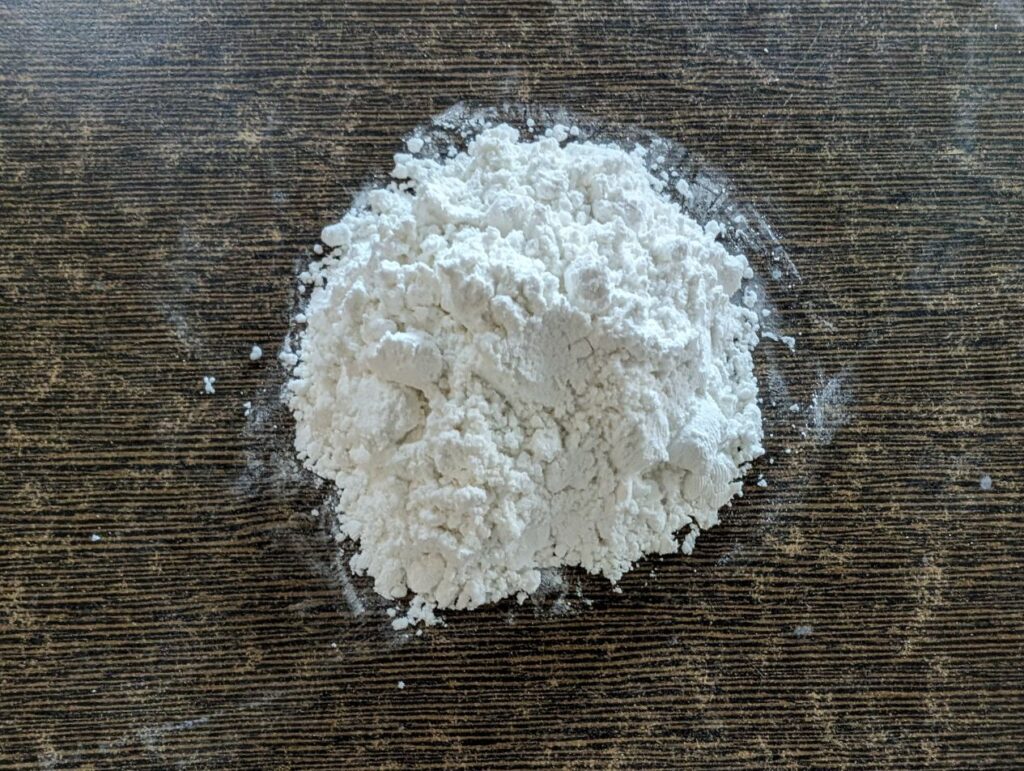
DTDM stands for 4,4′-Dithiodimorpholine.
It is commonly used in the rubber industry as a sulfur donor and vulcanization accelerator. During the vulcanization process, DTDM can contribute sulfur to the rubber curing system, helping form crosslinks between polymer chains.
The controlled sulfur-donor behavior of DTDM makes it useful in rubber formulations where manufacturers want to improve curing characteristics and heat-aging resistance while maintaining a suitable processing window.
DTDM Full Form
The full form of DTDM is:
DTDM = 4,4′-Dithiodimorpholine
It may also be referred to as Dithiodimorpholine or 4,4′-Dithiodimorpholine rubber accelerator.
DTDM Chemical Name and CAS Information
| Property | Information |
|---|---|
| Product name | DTDM |
| Full form | 4,4′-Dithiodimorpholine |
| Chemical family | Sulfur donor |
| Primary application | Rubber vulcanization |
| Industry | Rubber and polymer processing |
| Function | Sulfur donor / vulcanization accelerator |
| Physical form | Typically supplied as a solid chemical |
| Application | Rubber compounding |
Exact specifications such as purity, melting range, ash, moisture, and other parameters can vary according to the manufacturer and grade.
For industrial applications, buyers should always refer to the supplier’s current TDS (Technical Data Sheet), SDS (Safety Data Sheet), and certificate of analysis before final formulation approval.
How Does DTDM Work in Rubber Vulcanization?
Vulcanization is the process through which rubber is converted from a relatively soft and processable material into a stronger, more elastic and durable vulcanized product.
During conventional sulfur vulcanization, sulfur creates crosslinks between rubber polymer chains.
A simplified representation is:
Rubber polymer chains + curing system → sulfur crosslinks → vulcanized rubber
DTDM can act as a sulfur donor, releasing sulfur under appropriate vulcanization conditions.
This can help the compounder control the sulfur available to the curing system and influence the resulting crosslink structure.
The exact behavior depends on:
- Rubber polymer
- Accelerator combination
- Sulfur level
- DTDM dosage
- Activator system
- Vulcanization temperature
- Cure time
- Filler system
- Processing conditions
Therefore, DTDM should be evaluated as part of the complete curing system, rather than as an isolated ingredient.
Key Properties of Accelerator DTDM
DTDM is valued in rubber compounding because of its sulfur-donor characteristics and its ability to contribute to certain performance requirements.
Some of the important properties and formulation advantages associated with DTDM include:
1. Sulfur-Donor Capability
One of the primary functions of DTDM is to provide sulfur to the vulcanization system.
This makes it useful in formulations where the compounder wants to control the sulfur contribution without relying exclusively on elemental sulfur.
2. Improved Heat-Aging Performance
Appropriately designed curing systems using sulfur donors can contribute to improved resistance to heat aging.
This can be important for rubber products exposed to elevated temperatures during service.
3. Efficient Vulcanization
DTDM can contribute to efficient crosslink formation under suitable curing conditions.
Its effectiveness depends on the overall accelerator and sulfur system used in the formulation.
4. Controlled Sulfur Release
Compared with simply adding elemental sulfur, sulfur-donor systems can provide an alternative way of controlling the sulfur available during vulcanization.
This can be particularly useful in specialized rubber formulations.
5. Compatibility With Accelerator Systems
DTDM may be incorporated into formulations together with other accelerators depending on the polymer and performance requirements.
Common formulation decisions can involve combinations of:
- Primary accelerators
- Secondary accelerators
- Sulfur donors
- Sulfur
- Zinc oxide
- Stearic acid
- Retarders
DTDM in Rubber Compounding
Rubber compounding involves combining a polymer with a carefully selected group of chemicals and additives.
A typical formulation can contain:
- Natural rubber or synthetic rubber
- Carbon black or other reinforcing fillers
- Process oils
- Zinc oxide
- Stearic acid
- Sulfur
- Accelerators
- Antioxidants
- Antiozonants
- Processing aids
- Specialty additives
DTDM becomes part of the curing or vulcanization package.
The compounder selects the appropriate amount based on the required balance between:
Processing → Cure behavior → Crosslinking → Physical properties → Aging performance
This is why DTDM dosage cannot be treated as a universal fixed number for every rubber compound.
Applications of DTDM in Rubber
DTDM can be considered for a wide range of rubber applications where sulfur-donor functionality and controlled vulcanization are important.
1. Tyre Manufacturing
The tyre industry requires highly controlled rubber formulations because tyres must withstand:
- Heat
- Mechanical stress
- Repeated deformation
- Ozone exposure
- Aging
- Friction
- Dynamic loading
DTDM can be incorporated into selected tyre rubber formulations as part of the curing system.
Potential applications include various rubber compounds used in tyre components, depending on the formulation and manufacturer requirements.
2. Automotive Rubber Components
Automotive rubber components often operate under demanding conditions.
Examples include:
- Seals
- Gaskets
- Bushings
- Mounts
- Hoses
- Vibration-control components
- Other molded rubber parts
A suitable curing system can help manufacturers achieve the required balance of elasticity, strength, heat resistance, and durability.
3. Industrial Rubber Products
DTDM may also be considered in industrial rubber compounds used for:
- Conveyor belts
- Industrial hoses
- Rubber sheets
- Seals
- Gaskets
- Molded rubber components
- Mechanical rubber goods
The exact formulation depends on the required service conditions and polymer system.
4. Rubber Hoses
Rubber hoses can be exposed to pressure, temperature changes, mechanical movement, and chemicals.
A carefully designed vulcanization system helps establish the required physical properties and durability.
DTDM may be used as part of such curing systems where its sulfur-donor characteristics are appropriate.
5. Rubber Belts
Industrial belts require a combination of:
- Tensile strength
- Flex fatigue resistance
- Abrasion resistance
- Adhesion
- Heat resistance
- Dynamic durability
DTDM can be evaluated as one component of the vulcanization package used to develop these characteristics.
6. Seals and Gaskets
Seals and gaskets require dimensional stability and resistance to environmental conditions.
Depending on the polymer and application, DTDM can be incorporated into the curing system used for molded rubber sealing products.
Benefits of Using DTDM in Rubber Formulations
When correctly formulated, DTDM can offer several potential advantages.
Key benefits include:
- Sulfur-donor functionality
- Support for controlled vulcanization
- Potential contribution to heat-aging performance
- Useful in selected high-temperature rubber formulations
- Can be combined with other accelerators
- Helps compounders design specialized curing systems
- Suitable for various industrial rubber applications
However, performance depends strongly on the complete formulation.
More DTDM does not automatically mean better rubber performance.
The optimum level should be established through laboratory compounding and cure testing.
DTDM Dosage in Rubber
There is no single DTDM dosage that is suitable for every rubber compound.
The appropriate dosage depends on:
- Polymer type
- Sulfur content
- Accelerator system
- Cure temperature
- Cure time
- Desired crosslink density
- Required hardness
- Tensile properties
- Elongation
- Aging requirements
- Processing requirements
In practice, rubber compounders establish the optimum dosage through laboratory trials using rheometer data and physical-property testing.
Important cure parameters can include:
- Scorch time
- Minimum torque
- Maximum torque
- Cure time
- Cure rate
- Torque difference
Therefore, manufacturers should follow the supplier’s technical recommendations and validate the dosage in their own formulation.
DTDM and Sulfur Vulcanization
DTDM is particularly relevant when a compounder wants to modify the sulfur contribution of the curing system.
A conventional curing system may contain:
Sulfur + accelerator + activator
A sulfur-donor approach can instead incorporate a chemical such as DTDM to contribute sulfur during curing.
The objective is not simply to increase sulfur. The objective is to control the curing chemistry and achieve the required crosslink structure and performance.
This distinction is important for rubber formulation engineers.
DTDM vs Conventional Rubber Accelerators
DTDM should not always be considered a direct replacement for conventional accelerators such as MBT, MBTS, CBS, TBBS or TMTD.
Different chemicals perform different roles.
| Chemical | General role |
|---|---|
| MBT | Primary accelerator |
| MBTS | Delayed-action accelerator |
| CBS | Delayed-action accelerator |
| TBBS | Delayed-action accelerator |
| TMTD | Fast accelerator / sulfur donor |
| DPG | Secondary accelerator |
| DTDM | Sulfur donor |
| PVI | Vulcanization retarder |
The choice depends on the desired:
- Scorch safety
- Cure rate
- Cure characteristics
- Crosslink density
- Heat resistance
- Dynamic properties
- Processing behavior
A compounder may therefore use DTDM together with other accelerators rather than choosing DTDM as the only accelerator.
DTDM vs TMTD
DTDM and TMTD are both associated with sulfur-donor functionality, but their chemistry and behavior in rubber formulations are different.
DTDM
- 4,4′-Dithiodimorpholine
- Sulfur donor
- Used in selected vulcanization systems
- Can be useful where controlled sulfur contribution is desired
TMTD
- Tetramethylthiuram disulfide
- Very fast accelerator
- Also functions as a sulfur donor
- Used extensively in various rubber curing systems
The appropriate choice depends on the formulation and required cure characteristics.
For a production compound, the decision should be based on rheometer testing, processing behavior and final physical properties, rather than simply comparing the chemical names.
DTDM vs DPG
DPG (Diphenylguanidine) is generally used as a secondary accelerator, while DTDM primarily functions as a sulfur donor.
They therefore serve different formulation purposes.
DPG can be used to activate or modify the cure system, particularly in combination with other accelerators.
DTDM, on the other hand, contributes sulfur through its sulfur-donor function.
In some formulations, different additives may be combined to achieve the required curing profile.
DTDM in Different Rubber Polymers
The suitability of DTDM depends on the rubber polymer.
Potential evaluation areas include:
Natural Rubber (NR)
Natural rubber compounds often use sophisticated accelerator/sulfur systems. DTDM can be evaluated where its sulfur-donor characteristics fit the required cure profile.
Styrene-Butadiene Rubber (SBR)
SBR is widely used in tyres and industrial rubber products. DTDM can be considered as part of selected sulfur-curing systems.
Butadiene Rubber (BR)
BR is commonly used alongside other polymers in tyre formulations. The curing package must be optimized for the complete polymer blend.
EPDM
EPDM compounds can use sulfur-based curing systems. DTDM may be evaluated depending on the formulation and required heat-aging performance.
Other Synthetic Rubbers
Suitability should always be confirmed through formulation trials because different polymers respond differently to accelerator and sulfur systems.
Factors to Consider When Selecting DTDM
Rubber manufacturers should consider several factors before purchasing DTDM.
1. Chemical Purity
Consistent purity is important for maintaining batch-to-batch formulation consistency.
2. Product Specification
Review:
- Purity
- Moisture
- Ash
- Melting range
- Physical appearance
- Other relevant quality parameters
3. Consistency Between Batches
Industrial rubber production requires consistent raw materials because variations can affect cure behavior and final properties.
4. Packaging
Packaging should protect the product from contamination and unsuitable environmental conditions during storage and transportation.
5. Technical Support
For large-volume users, technical support can be valuable when optimizing curing systems.
6. Supply Reliability
For continuous production, manufacturers should evaluate:
- Production capacity
- Lead time
- Export capability
- Documentation
- Batch consistency
- Logistics
- Customer support
Storage and Handling of DTDM
DTDM should be stored and handled according to the manufacturer’s current SDS and applicable local regulations.
General good practices include:
- Store in a cool, dry and well-ventilated area.
- Keep containers properly closed.
- Protect the material from contamination.
- Avoid unnecessary exposure to heat and moisture.
- Follow appropriate industrial hygiene procedures.
- Use suitable personal protective equipment.
- Consult the SDS for detailed handling, storage and emergency procedures.
For industrial procurement, buyers should request the latest SDS, TDS and Certificate of Analysis (COA) from their chemical supplier.
Why Product Quality Matters in DTDM
Rubber manufacturing is highly sensitive to raw-material consistency.
Even relatively small changes in a curing ingredient can affect:
- Cure time
- Scorch behavior
- Crosslink density
- Hardness
- Tensile strength
- Elongation
- Compression set
- Heat aging
- Finished-product consistency
For this reason, industrial buyers should source DTDM from a supplier capable of maintaining consistent specifications and reliable batch quality.
A supplier’s manufacturing controls, laboratory testing, documentation and supply-chain reliability can be just as important as the nominal chemical specification.
How to Buy DTDM in Bulk
For industrial buyers looking for DTDM rubber accelerator, it is important to provide the supplier with enough information to recommend the appropriate grade and supply configuration.
A bulk enquiry can include:
- Required quantity
- Application
- Rubber polymer
- Current formulation
- Required specification
- Packaging requirement
- Delivery location
- Domestic or export requirement
- Required documentation
- Expected annual consumption
This allows the supplier to respond more accurately regarding availability, technical specifications, packaging and commercial terms.
Why Choose a Specialized Rubber Chemical Supplier?
A specialized rubber chemical manufacturer can provide more than just the chemical itself.
For rubber manufacturers, an experienced supplier can support:
Product selection → Technical documentation → Sample evaluation → Formulation trials → Bulk supply → Quality consistency → Repeat production
This is especially valuable for tyre manufacturers and industrial rubber producers where raw-material consistency directly influences production performance.
Frequently Asked Questions About Accelerator DTDM
What is the full form of DTDM?
DTDM stands for 4,4′-Dithiodimorpholine. It is primarily used as a sulfur donor in rubber vulcanization systems.
What is DTDM used for?
DTDM is used in rubber compounding as a sulfur donor and vulcanization-system component. It can be considered for applications requiring controlled sulfur contribution and suitable curing and heat-aging performance.
Is DTDM a rubber accelerator?
DTDM is commonly classified in the rubber industry as a sulfur donor and can function as a vulcanization accelerator-system component. Its exact role depends on the formulation.
What is the difference between DTDM and TMTD?
Both can contribute sulfur to rubber curing systems, but they are chemically different and have different cure characteristics. TMTD is generally recognized as a fast accelerator and sulfur donor, while DTDM is primarily used for its sulfur-donor function.
Can DTDM be used with other accelerators?
Yes. DTDM can be incorporated into combination curing systems with other rubber accelerators, depending on the polymer, cure requirements and desired physical properties.
Is DTDM suitable for tyre manufacturing?
DTDM can be evaluated in selected tyre rubber formulations as part of the vulcanization system. Suitability depends on the specific tyre compound and required performance.
What is the recommended DTDM dosage?
There is no universal dosage. The optimum level depends on the polymer, sulfur system, accelerator combination, cure temperature and required final properties. Laboratory rheometer and physical-property testing should be used to establish the appropriate level.
How should DTDM be stored?
DTDM should generally be stored in a cool, dry and well-ventilated location in properly closed packaging. Always follow the latest supplier SDS for specific storage and handling requirements.
Where can I buy DTDM in bulk?
Industrial buyers can approach specialized rubber chemical manufacturers and suppliers for bulk DTDM requirements. Before placing an order, buyers should request the current TDS, SDS, COA, specification and packaging details.
DTDM for Rubber Manufacturers and Bulk Buyers
For manufacturers, the right rubber chemical supplier is an important part of maintaining consistent production.
When sourcing DTDM rubber accelerator, evaluate more than price. Consider:
- Product quality
- Purity and specification
- Batch-to-batch consistency
- Technical documentation
- Manufacturing capability
- Packaging
- Delivery reliability
- Export experience
- Technical support
- Long-term supply capacity
A reliable supply of consistent DTDM can help rubber manufacturers maintain stable formulation and production performance.
Get DTDM and Other Rubber Chemicals for Your Formulation
Arihant Reclamation Pvt. Ltd. (ARPL) supplies a range of rubber chemicals for industrial rubber and polymer applications, including rubber accelerators, antioxidants/antidegradants and other rubber-compounding chemicals.
For DTDM bulk requirements, product specifications, technical documentation, pricing and availability, industrial buyers can contact ARPL directly.
Bulk & Enquiry: +91-8860732624
When contacting a supplier, mention your required quantity, application, rubber polymer and specification so the team can provide the most relevant product information.
Conclusion
Accelerator DTDM, or 4,4′-Dithiodimorpholine, is an important sulfur-donor chemical used in rubber vulcanization systems. Its controlled sulfur-donor functionality makes it useful for selected rubber formulations where manufacturers are looking to optimize curing behavior and performance.
DTDM can be considered for applications including tyres, automotive rubber components, industrial rubber products, hoses, belts, seals and gaskets, depending on the polymer and formulation.
The most important point is that DTDM should not be selected based solely on its name or generic dosage recommendation. The best results come from evaluating it within the complete rubber curing system, including sulfur, accelerators, activators, polymer, fillers and processing conditions.
For industrial users, consistent quality, reliable supply, technical documentation and application support are equally important when selecting a DTDM rubber chemical supplier.
Looking for DTDM for your rubber formulation? Contact ARPL for bulk requirements and enquiries at +91-8860732624.