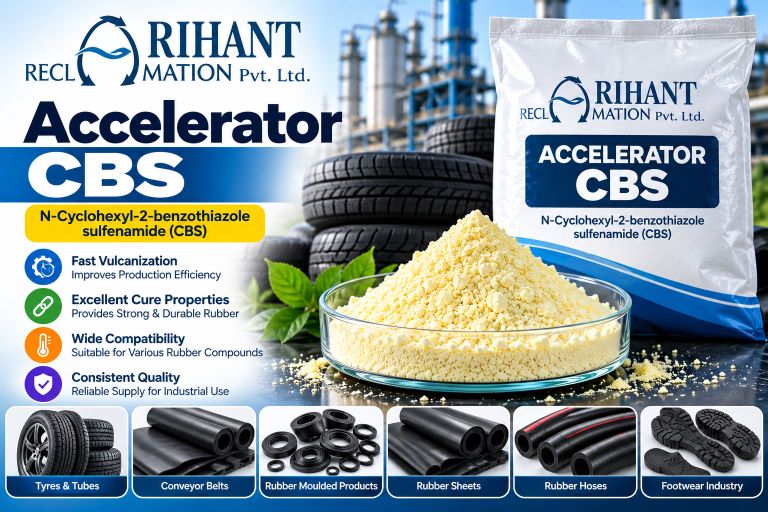
Accelerator CBS is an important rubber vulcanization accelerator used in the production of tyres and a wide range of industrial rubber products. Also known as CBS rubber accelerator, CZ accelerator, and N-cyclohexyl-2-benzothiazolesulfenamide, this chemical is valued for its delayed-action characteristics and its role in supporting controlled vulcanization in suitable rubber formulations.
Arihant Reclamation Pvt. Ltd. (ARPL) provides information and solutions across a range of rubber processing chemicals, including rubber accelerators, antioxidants, retarders, and zinc oxide. Manufacturers looking for a CBS accelerator for rubber, rubber vulcanization chemicals, or industrial rubber chemical suppliers can contact ARPL to discuss their requirements, specifications, and availability.
For product information, visit Accelerator CBS or view the complete ARPL rubber chemicals product range.
What Is Accelerator CBS?
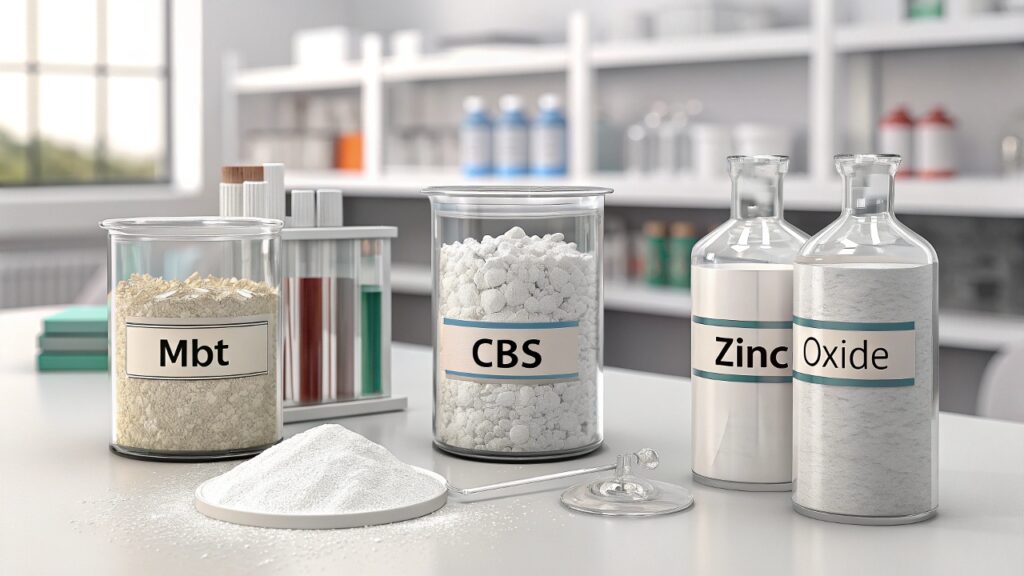
Accelerator CBS is a sulfenamide-type rubber accelerator widely used to promote vulcanization in rubber compounds. Its delayed-action behaviour can help rubber manufacturers manage processing time before curing begins, while supporting the development of the required cured properties when used in a properly designed formulation.
CBS is commonly used in natural rubber (NR) and suitable synthetic rubber compounds. Its selection depends on the rubber polymer, curing system, processing conditions, product design, and the properties required in the finished rubber component.
| Product detail | Information |
|---|---|
| Chemical name | N-cyclohexyl-2-benzothiazolesulfenamide |
| Common name | Accelerator CBS |
| Alternative designation | CZ rubber accelerator |
| Chemical category | Sulfenamide rubber accelerator |
| Primary function | Rubber vulcanization acceleration |
| Main industry | Rubber processing and manufacturing |
| Common applications | Tyres, treads, belts, hoses, and industrial rubber goods |
| Product information | ARPL Accelerator CBS |
Specifications and product grades should be confirmed against the current technical data sheet (TDS) and certificate of analysis (COA) for the material being purchased.
Key Benefits of Accelerator CBS in Rubber Compounding
CBS rubber accelerator is used where manufacturers need a balance between processing safety and curing efficiency. Its performance depends on the formulation, temperature, rubber type, and curing system.
- Delayed-action vulcanization: Helps provide processing time before significant curing begins.
- Scorch safety: Supports reduced risk of premature vulcanization when the compound is correctly formulated and processed.
- Efficient curing: Helps achieve suitable cure rates under the intended vulcanization conditions.
- Rubber property development: Contributes to the development of required physical properties in the finished compound.
- Versatile applications: Used in tyre compounds and a broad range of technical and industrial rubber products.
- Formulation flexibility: Can be used in different accelerator systems depending on the compound design.
Accelerator CBS Uses and Applications
Accelerator CBS is used in rubber processing for products that require controlled vulcanization and reliable compound performance. Its suitability should always be assessed against the manufacturer’s formulation and technical requirements.
| Industry or product | Role of CBS rubber accelerator |
|---|---|
| Automobile tyres | Used in suitable tyre tread and other tyre rubber compounds |
| Truck and bus tyres | Supports vulcanization in appropriately formulated heavy-duty tyre compounds |
| Two-wheeler and bicycle tyres | Used in tyre and tube rubber formulations |
| Conveyor belts | Supports curing of industrial belt compounds |
| Transmission and V-belts | Used in suitable power-transmission rubber compounds |
| Rubber hoses and tubing | Helps vulcanize suitable hose and tubing formulations |
| Footwear manufacturing | Used in selected rubber soles and footwear components |
| Automotive rubber parts | Used in appropriate moulded and extruded components |
| Rubber seals and gaskets | Supports curing in compatible industrial rubber formulations |
| Cable and wire components | Used in selected rubber insulation and protective compounds |
| Tyre retreading and repair | May be incorporated into suitable retreading and repair compounds |
| Industrial rubber goods | Used in various moulded, compression-moulded, transfer-moulded and extruded rubber products |
ARPL lists these application categories on its Accelerator CBS product page.
CBS Accelerator for Natural and Synthetic Rubber
CBS is used in several rubber polymer systems, subject to formulation compatibility and processing requirements.
- Natural Rubber (NR): Used in rubber compounds for tyres and industrial rubber products.
- Styrene-Butadiene Rubber (SBR): Used in suitable tread and general-purpose rubber compounds.
- Polybutadiene Rubber (BR): Can be used in compatible rubber blends and tyre-related formulations.
- Natural Rubber and SBR Blends (NR/SBR): Used where the formulation calls for a suitable delayed-action accelerator.
- Nitrile Rubber (NBR): Used in selected industrial rubber compounds.
- Ethylene Propylene Diene Monomer (EPDM): Can be used in suitable sulphur-cured EPDM formulations.
- Isoprene Rubber (IR): Used in compatible vulcanization systems.
The suitability of CBS depends on the polymer, sulphur level, other accelerators, fillers, processing temperatures and desired cure characteristics. Confirm compatibility and dosage through formulation trials and technical guidance.
Accelerator CBS vs Other Rubber Accelerators
Rubber manufacturers select accelerators according to cure speed, scorch safety, polymer compatibility and final-product requirements. CBS is not interchangeable with every accelerator.
| Rubber chemical | Main category or role | Product information |
|---|---|---|
| Accelerator CBS | Delayed-action sulfenamide accelerator | View CBS |
| Accelerator MBT | Benzothiazole accelerator | View MBT |
| Accelerator MBTS | Benzothiazole disulphide accelerator | View MBTS |
| Accelerator TBBS | Sulfenamide accelerator | View TBBS |
| Accelerator TMTD | Thiuram accelerator | View TMTD |
| Accelerator ZDEC | Dithiocarbamate accelerator | View ZDEC |
| Accelerator ZDBC | Dithiocarbamate accelerator | View ZDBC |
| Zinc Oxide | Common rubber compounding activator | View Zinc Oxide |
For more rubber chemical terminology, abbreviations and applications, read the Rubber Chemicals Full Forms and Uses Guide.
Accelerator CBS Chemical Specifications
The following table identifies the main chemical details buyers commonly use when sourcing CBS. Exact specifications, test results and product form must be verified against the current supplier documentation.
| Parameter | Details |
|---|---|
| Product name | Accelerator CBS |
| Chemical name | N-cyclohexyl-2-benzothiazolesulfenamide |
| Abbreviation | CBS |
| Alternative name | Accelerator CZ |
| CAS number | 95-33-0 |
| Molecular formula | C₁₃H₁₆N₂S₂ |
| Chemical class | Sulfenamide |
| Function | Rubber vulcanization accelerator |
| Appearance listed by ARPL | Off-white powder |
| Technical documents | Request the current TDS and COA |
How to Choose an Accelerator CBS Supplier
When sourcing CBS accelerator for rubber manufacturing, buyers should assess more than the quoted price. Consider the following factors before placing an order:
- Product specifications: Confirm chemical identity, appearance, assay and relevant quality parameters.
- Technical documentation: Request the current technical data sheet (TDS), certificate of analysis (COA) and safety data sheet (SDS).
- Application suitability: Check that the product matches your rubber polymer and curing system.
- Consistency between batches: Discuss quality-control procedures and batch documentation.
- Packaging requirements: Confirm available packaging, storage recommendations and transport arrangements.
- Order quantity: Share your required quantity and expected purchasing frequency.
- Commercial terms: Compare price, payment terms, lead time and delivery arrangements.
- Supplier communication: Choose a supplier that can clearly respond to technical and procurement questions.
Accelerator CBS Price and Bulk Purchase Enquiries
The price of Accelerator CBS can vary according to product grade, specifications, order volume, packaging, market conditions, freight and delivery location. A reliable quotation should be based on the required quantity and confirmed product specifications rather than a generic online price.
For Accelerator CBS price in India, CBS rubber accelerator bulk requirements, industrial rubber chemical sourcing or product availability, contact Arihant Reclamation Pvt. Ltd. with your intended application and quantity.
ARPL can be contacted to discuss product information, commercial requirements and current availability.
Why Contact ARPL for Accelerator CBS?
Arihant Reclamation Pvt. Ltd. offers a portfolio of rubber processing chemicals for industrial applications. Buyers can review its rubber accelerator range and discuss requirements for CBS and related rubber chemicals.
- Product information for rubber manufacturing requirements.
- Access to a wider portfolio of rubber accelerators and related chemicals.
- Enquiries for industrial rubber applications and bulk requirements.
- Direct communication about specifications, availability and delivery terms.
- Product links to related chemicals for easier technical review.
View Accelerator CBS by ARPL or visit the complete product catalogue.
Contact ARPL for Accelerator CBS
For Accelerator CBS product enquiries, rubber vulcanization chemicals, industrial rubber accelerators and bulk purchasing requirements, contact Arihant Reclamation Pvt. Ltd.
- Company: Arihant Reclamation Pvt. Ltd. (ARPL)
- Phone: +91-8860-732-624 / +91-9625-671-802
- Email: arihantreclamationpvtltd@gmail.com
- Address: 40.3 km Milestone, GT Road, Bahalgarh, Sonepat, Haryana 131021, India
- Product page: Accelerator CBS
Contact the team with your required quantity, application and specification needs to discuss current product availability and commercial terms.
Frequently Asked Questions About Accelerator CBS
1. What is Accelerator CBS used for?
Accelerator CBS is a sulfenamide-type rubber vulcanization accelerator used in suitable natural and synthetic rubber compounds. Common applications include tyre manufacturing, conveyor belts, hoses, footwear and industrial rubber goods.
2. What is the chemical name of CBS accelerator?
The chemical name is N-cyclohexyl-2-benzothiazolesulfenamide. It is also commonly known as Accelerator CZ.
3. What is the CAS number of Accelerator CBS?
The CAS Registry Number for CBS is 95-33-0.
4. What are the main benefits of CBS rubber accelerator?
CBS is known for delayed-action vulcanization, good scorch safety and efficient curing under appropriate processing conditions. Actual results depend on the rubber formulation and operating conditions.
5. Is CBS used in tyre manufacturing?
Yes. CBS is used in suitable tyre rubber compounds, including formulations for tyre treads and other tyre components. The precise application depends on the compound design.
6. Can CBS be used with natural and synthetic rubber?
Yes. CBS is used in compatible formulations involving natural rubber and various synthetic rubbers, including SBR, BR, NBR and certain EPDM systems. Compatibility should be verified for the specific formulation.
7. What is the difference between CBS and MBTS?
CBS is a sulfenamide accelerator known for delayed-action behaviour. MBTS is a benzothiazole disulphide accelerator with different curing characteristics. Selection depends on the rubber compound, processing conditions and target properties.
8. What factors affect the price of CBS accelerator?
Price can depend on grade, specifications, quantity, packaging, market conditions, freight and delivery terms. Buyers should request a current quotation for their specific requirements.
9. Where can I enquire about Accelerator CBS in India?
You can contact Arihant Reclamation Pvt. Ltd. for CBS product information, specifications and availability enquiries using the contact details below.
10. What documents should I request before purchasing CBS?
Request the current TDS, COA and SDS. These documents help verify the material’s specifications, batch results, handling precautions and suitability for the intended use.