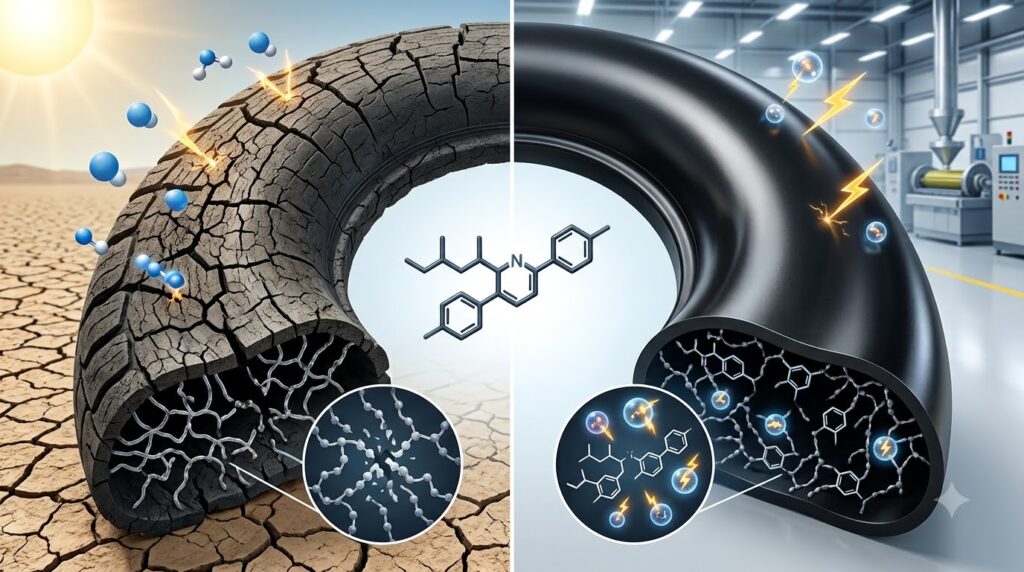
Antioxidant 6PPD is one of the most important antidegradants used in the rubber industry. It is widely used in tyre manufacturing, automotive rubber products, industrial rubber goods, hoses, belts, seals and other rubber applications where protection against ozone, oxidation, heat and flex-cracking is required.
6PPD helps extend the service life of rubber products by protecting vulcanized rubber from environmental degradation. It is particularly important in applications exposed to ozone, oxygen, heat, repeated flexing and dynamic conditions.
In this comprehensive guide, we explain 6PPD full form, chemical name, properties, uses, applications, benefits, dosage considerations, mechanism of action and role in rubber compounding.
What Is Antioxidant 6PPD?
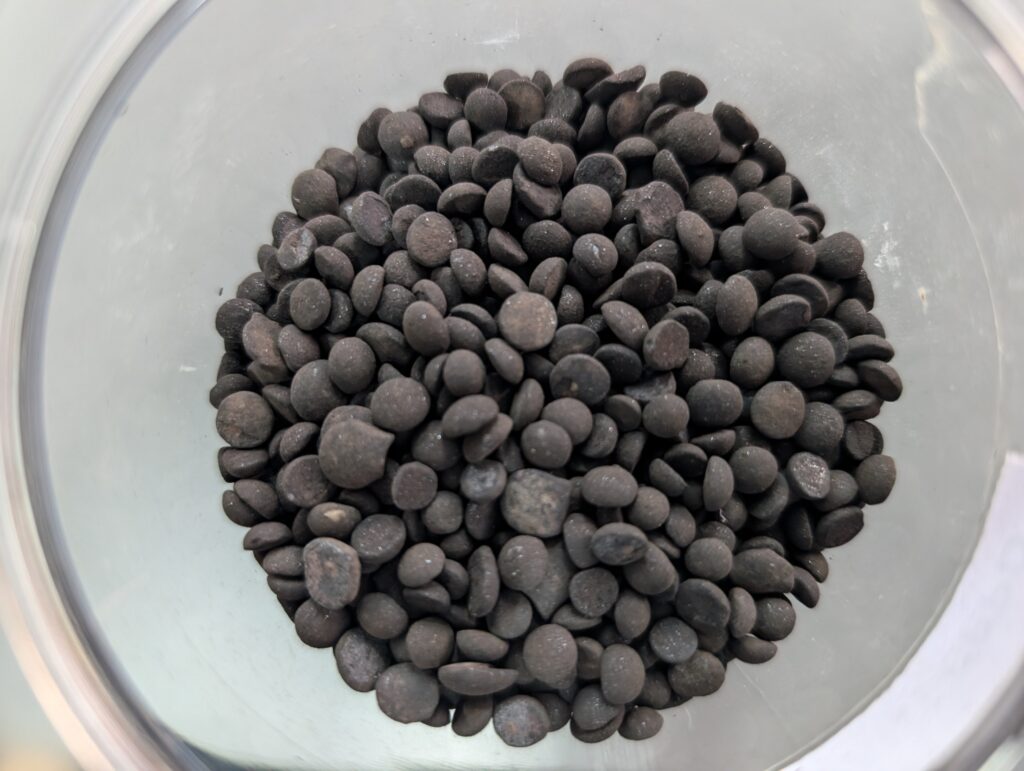
6PPD stands for N-(1,3-dimethylbutyl)-N’-phenyl-p-phenylenediamine.
It is a p-phenylenediamine (PPD) antidegradant widely used to protect rubber against degradation caused by ozone and oxygen.
Although commonly called an antioxidant, 6PPD is more accurately described as a multifunctional antidegradant, particularly valued for its strong antiozonant performance.
In rubber compounds, 6PPD can help prevent surface cracking and deterioration caused by exposure to ozone and atmospheric oxygen.
6PPD Full Form
The full chemical name of 6PPD is:
N-(1,3-dimethylbutyl)-N’-phenyl-p-phenylenediamine
It is also commonly identified as:
- 6PPD
- 4020
- N-(1,3-dimethylbutyl)-N’-phenyl-1,4-phenylenediamine
- 6PPD antioxidant
- 6PPD antiozonant
- Rubber antioxidant 6PPD
Why Is 6PPD Important in Rubber?
Rubber products can deteriorate when exposed to environmental conditions such as:
- Oxygen
- Ozone
- Heat
- UV exposure
- Mechanical flexing
- Atmospheric aging
Ozone is particularly damaging to many unsaturated rubber polymers.
When susceptible rubber is exposed to ozone, chemical reactions can occur at the rubber surface. These reactions can eventually produce ozone cracks, especially when the rubber is under tensile strain or repeated flexing.
6PPD helps protect the rubber by reacting preferentially with ozone and other reactive species before they can cause extensive damage to the polymer.
This makes 6PPD particularly valuable in tyre and dynamic rubber applications.
How Does 6PPD Work?
6PPD primarily works through a protective mechanism known as sacrificial protection.
When ozone or other oxidizing species attack the rubber compound, 6PPD migrates toward the rubber surface and reacts with the attacking species.
Instead of allowing ozone to rapidly attack the rubber polymer chains, the antidegradant reacts preferentially.
A simplified mechanism can be represented as:
Ozone exposure → 6PPD reacts with ozone → rubber polymer receives protection → reduced ozone cracking
6PPD can also participate in protecting rubber against oxidative degradation.
Its effectiveness depends on several factors, including:
- 6PPD concentration
- Rubber polymer
- Carbon black and filler system
- Wax system
- Processing conditions
- Temperature
- Exposure conditions
- Dynamic strain
- Surface migration characteristics
Therefore, 6PPD performance should always be evaluated as part of the complete rubber formulation.
Key Properties of 6PPD
6PPD is widely selected by rubber manufacturers because of its combination of antiozonant and antioxidant properties.
Important characteristics include:
1. Strong Antiozonant Performance
6PPD provides effective protection against ozone-induced degradation in many rubber compounds.
This is one of its most important functions.
2. Antioxidant Protection
6PPD helps protect rubber from oxidative degradation caused by oxygen and other reactive species.
3. Protection Against Flex Cracking
In dynamic rubber products, repeated deformation can accelerate ozone cracking.
6PPD can help reduce the development of ozone-related cracks under suitable formulation conditions.
4. Surface Protection
6PPD has suitable migration characteristics that allow it to reach the rubber surface and provide ongoing protection.
5. Wide Industrial Use
6PPD is used extensively in:
- Tyres
- Automotive rubber
- Industrial rubber
- Hoses
- Belts
- Seals
- Rubber components
6PPD Chemical Information
| Property | Information |
|---|---|
| Product | 6PPD |
| Common designation | 4020 |
| Chemical family | p-Phenylenediamine |
| Full chemical name | N-(1,3-dimethylbutyl)-N’-phenyl-p-phenylenediamine |
| Primary function | Antiozonant / antidegradant |
| Secondary function | Antioxidant |
| Industry | Rubber and tyre manufacturing |
| Main application | Rubber compounding |
| Typical physical form | Solid rubber chemical |
The exact commercial specification may vary between manufacturers and grades. Industrial buyers should always verify the current Technical Data Sheet (TDS), Safety Data Sheet (SDS) and Certificate of Analysis (COA) before approving a product.
Applications of 6PPD in Rubber
6PPD is used across numerous rubber applications.
1. 6PPD in Tyre Manufacturing
The tyre industry is one of the most important applications for 6PPD.
Tyres are exposed to:
- Ozone
- Oxygen
- Heat
- Sunlight
- Water
- Road chemicals
- Mechanical stress
- Repeated flexing
These conditions can accelerate rubber aging.
6PPD is therefore incorporated into many tyre compounds to provide protection against ozone cracking and oxidative degradation.
It can be used in various tyre components depending on the manufacturer’s formulation and performance requirements.
Why 6PPD Is Important for Tyres
Tyres continuously flex while in service.
When rubber is exposed to ozone while under strain, cracks can develop on the surface.
6PPD helps reduce this degradation and contributes to improved durability of suitable rubber compounds.
2. Automotive Rubber Components
6PPD is also relevant to automotive rubber products such as:
- Hoses
- Seals
- Gaskets
- Bushings
- Mounts
- Belts
- Vibration-control components
- Molded rubber parts
Automotive components can experience elevated temperatures, oxygen, ozone and repeated mechanical movement.
A properly designed antidegradant system can therefore be important for long-term performance.
3. Industrial Rubber Products
Industrial rubber products may operate outdoors or under demanding mechanical conditions.
Applications can include:
- Conveyor belts
- Industrial hoses
- Rubber sheets
- Rubber profiles
- Seals
- Gaskets
- Rollers
- Molded rubber products
6PPD can be incorporated into suitable formulations where ozone and oxidative protection are required.
4. Rubber Hoses
Rubber hoses can be exposed to atmospheric ozone and repeated bending.
6PPD can help protect susceptible rubber polymers from ozone-related degradation.
This can be particularly important for hoses used in:
- Automotive applications
- Industrial equipment
- Outdoor environments
- Machinery
The exact antidegradant system depends on the polymer and service conditions.
5. Rubber Belts
Belts used in industrial and automotive applications can experience continuous flexing.
Ozone and oxygen can contribute to rubber degradation over time.
6PPD may therefore be used as part of the antidegradant package in appropriate rubber belt compounds.
6. Seals and Gaskets
Rubber seals and gaskets need to retain their physical properties over extended periods.
Depending on the polymer and application, 6PPD can provide protection against environmental aging.
This can help support:
- Crack resistance
- Durability
- Aging resistance
- Long-term performance
6PPD in Natural Rubber
Natural rubber is widely used in tyres and industrial rubber products.
Because natural rubber contains unsaturation that can be susceptible to ozone attack, an effective antiozonant system is often important.
6PPD can be incorporated into natural rubber formulations to provide protection against:
- Ozone
- Oxygen
- Flex cracking
- Environmental aging
The optimum level depends on the complete formulation and product requirements.
6PPD in Synthetic Rubber
6PPD is also used with various synthetic rubber polymers.
Its suitability depends on the chemical structure and characteristics of the polymer.
It can be considered for compounds based on polymers such as:
- SBR
- BR
- NR/SBR blends
- NR/BR blends
- Other suitable diene rubber systems
The formulation engineer must evaluate compatibility, migration, blooming behavior and required aging performance.
Benefits of Using 6PPD in Rubber Formulations
When appropriately formulated, 6PPD can provide several important benefits.
Major advantages include:
- Excellent protection against ozone
- Protection against oxidative aging
- Reduced ozone cracking
- Improved resistance to flex cracking
- Better environmental aging resistance
- Suitable for dynamic rubber products
- Widely established in tyre formulations
- Compatible with many conventional rubber compounding systems
The actual performance depends on the rubber polymer, dosage and complete formulation.
6PPD and Ozone Cracking
Ozone cracking is one of the major degradation mechanisms affecting susceptible rubber.
The process can be simplified as:
Ozone + susceptible rubber + strain → surface cracking
These cracks may become increasingly severe when the rubber is repeatedly stretched.
6PPD helps interrupt this process by reacting with ozone before ozone can cause extensive attack on the rubber polymer.
This is why antiozonants such as 6PPD are particularly important for tyres and other dynamic rubber products.
What Is the Difference Between 6PPD and an Ordinary Antioxidant?
The terms “antioxidant” and “antiozonant” are sometimes used interchangeably in the rubber industry, but they describe somewhat different protection mechanisms.
Antioxidants
Primarily help reduce degradation caused by oxidative reactions.
Antiozonants
Primarily protect rubber against ozone attack.
6PPD
6PPD is particularly valuable because it provides both antioxidant and antiozonant protection, with strong performance against ozone degradation.
This multifunctional behavior explains its widespread use in tyre and rubber formulations.
6PPD vs TMQ
Both 6PPD and TMQ are important rubber antidegradants, but they have different characteristics.
| Feature | 6PPD | TMQ |
|---|---|---|
| Chemical family | P-Phenylenediamine | Polymerized quinoline |
| Main function | Antiozonant + antioxidant | Antioxidant |
| Ozone protection | Strong | Generally lower than PPD antiozonants |
| Heat-aging protection | Good | Strong |
| Dynamic applications | Very important | Widely used |
| Tyre applications | Extensive | Extensive |
In many rubber formulations, 6PPD and TMQ may be used together because they can provide complementary protection.
6PPD vs IPPD
Both 6PPD and IPPD belong to the p-phenylenediamine antidegradant family.
6PPD
N-(1,3-dimethylbutyl)-N’-phenyl-p-phenylenediamine
IPPD
N-isopropyl-N’-phenyl-p-phenylenediamine
Both can provide antiozonant and antioxidant protection.
However, they differ in chemical structure, migration characteristics and performance.
The selection should be based on:
- Polymer
- Service environment
- Temperature
- Ozone exposure
- Dynamic conditions
- Required protection
- Formulation compatibility
6PPD Dosage in Rubber
The appropriate 6PPD dosage depends on the specific rubber formulation.
There is no universal dosage suitable for every application.
Important factors include:
- Rubber polymer
- Ozone exposure
- Expected service life
- Temperature
- Dynamic strain
- Carbon black loading
- Wax content
- Other antioxidants
- Required aging resistance
- Product specification
The optimum concentration should be established through laboratory testing.
Rubber compounders may evaluate:
- Ozone resistance
- Heat-aging properties
- Tensile strength
- Elongation
- Hardness
- Crack growth
- Flex resistance
- Rheometer characteristics
Always follow the supplier’s technical recommendations and validate the final formulation through appropriate testing.
Factors Affecting 6PPD Performance
The effectiveness of 6PPD does not depend only on its concentration.
Several formulation variables can influence performance.
Polymer Type
Different polymers have different susceptibility to ozone and oxidation.
Temperature
Higher temperatures can accelerate chemical aging and influence migration and consumption of antidegradants.
Ozone Exposure
Outdoor and high-ozone environments may require stronger protection.
Mechanical Strain
Ozone cracking becomes particularly important when rubber is under tensile strain.
Wax System
Waxes can work together with antiozonants by forming a protective surface layer.
Other Antidegradants
The presence of antioxidants and other protective chemicals can affect overall aging performance.
6PPD in Tyre Formulation
A typical tyre rubber compound may contain a combination of:
- Natural rubber
- Synthetic rubber
- Carbon black
- Silica
- Process oils
- Zinc oxide
- Stearic acid
- Sulfur
- Accelerators
- Antioxidants
- Antiozonants
- Processing additives
6PPD forms part of the antidegradant package.
A simplified formulation concept is:
Rubber polymer + fillers + curing system + 6PPD + other additives → vulcanized tyre compound
The exact formulation is highly application-specific and is normally developed through extensive laboratory and production testing.
Why 6PPD Quality Matters
For industrial rubber manufacturers, consistency in 6PPD quality is extremely important.
Changes in raw-material quality can potentially affect:
- Cure behavior
- Aging resistance
- Ozone protection
- Blooming
- Migration
- Finished-product durability
- Batch-to-batch consistency
A reliable supplier should therefore provide consistent material along with appropriate technical documentation.
Before bulk procurement, buyers should evaluate:
- Purity
- Appearance
- Melting point/range
- Ash
- Moisture
- Other relevant specifications
- Batch consistency
- Packaging
- Shelf life
- COA
- SDS
- TDS
How to Select a 6PPD Supplier
When purchasing 6PPD rubber antioxidant in bulk, price should not be the only consideration.
Industrial buyers should evaluate:
Product Quality
Check whether the product meets the required specification.
Batch Consistency
Consistent quality is essential for repeatable rubber compounding.
Manufacturing Capability
Evaluate production capacity and quality-control systems.
Documentation
The supplier should be able to provide appropriate:
- TDS
- SDS
- COA
- Product specifications
Supply Reliability
For large tyre and rubber manufacturers, uninterrupted supply is critical.
Technical Support
A technically capable supplier can help customers understand product specifications and application considerations.
Packaging and Logistics
Packaging should be appropriate for transportation, storage and handling.
Storage and Handling of 6PPD
6PPD should be stored and handled according to the manufacturer’s latest Safety Data Sheet (SDS) and applicable regulations.
General industrial practices include:
- Store in a cool and dry location.
- Keep containers properly sealed.
- Protect from contamination.
- Avoid unnecessary exposure to heat and moisture.
- Maintain appropriate ventilation.
- Follow recommended personal protective equipment requirements.
- Consult the SDS for detailed handling and emergency information.
The supplier’s current SDS should always take precedence over generic handling guidance.
How to Buy 6PPD in Bulk
For tyre manufacturers, rubber compounders and industrial buyers, a bulk enquiry should ideally include:
- Required quantity
- Application
- Rubber polymer
- Required specification
- Packaging requirement
- Delivery location
- Domestic or export requirement
- Required documentation
- Estimated annual consumption
Providing these details helps a supplier respond with appropriate information regarding grade, availability, packaging, lead time and commercial terms.
Why Choose a Specialized Rubber Chemical Manufacturer?
A specialized rubber chemical supplier can provide more than a commodity chemical.
For industrial users, the ideal supply relationship includes:
Consistent product → Technical documentation → Sample evaluation → Quality control → Bulk supply → Reliable logistics → Long-term support
This becomes especially important for tyre and automotive rubber manufacturers because changes in antidegradant quality can influence finished-product performance.
Frequently Asked Questions About Antioxidant 6PPD
What is the full form of 6PPD?
6PPD stands for N-(1,3-dimethylbutyl)-N’-phenyl-p-phenylenediamine.
What is 6PPD used for?
6PPD is used primarily as an antiozonant and antioxidant in rubber formulations. It helps protect rubber from ozone cracking, oxidation and environmental aging.
Is 6PPD an antioxidant or antiozonant?
6PPD provides both functions, but it is particularly well known for its antiozonant performance in rubber compounds.
Why is 6PPD used in tyres?
Tyres experience ozone exposure, oxygen, heat and repeated flexing. 6PPD helps protect susceptible rubber compounds against ozone cracking and oxidative degradation.
What is another name for 6PPD?
6PPD is commonly known as 4020 in the rubber industry.
What is the difference between 6PPD and TMQ?
6PPD is a p-phenylenediamine antidegradant with strong antiozonant activity, while TMQ is primarily used as an antioxidant for heat and oxidative aging. They can be used together in suitable formulations.
Can 6PPD be used with other antioxidants?
Yes. 6PPD can be combined with other antidegradants such as TMQ depending on the polymer, application and desired aging protection.
What is the recommended dosage of 6PPD?
There is no universal dosage. The optimum amount depends on the polymer, ozone exposure, temperature, dynamic conditions and complete formulation. Laboratory testing should be used to determine the appropriate level.
Is 6PPD suitable for natural rubber?
Yes. 6PPD is widely used in natural rubber and other diene-rubber formulations where ozone and oxidative protection are required.
Where can I buy 6PPD in bulk?
Industrial buyers can source 6PPD from specialized rubber chemical manufacturers and suppliers. Buyers should request the latest TDS, SDS, COA and product specification before purchasing.
6PPD for Tyre and Rubber Manufacturers
For manufacturers looking for 6PPD antioxidant, 6PPD antiozonant or 4020 rubber chemical, selecting a consistent industrial-grade material is important.
A good supplier should be able to support customers with:
- Product specifications
- Technical documentation
- Quality certificates
- Bulk quantities
- Suitable packaging
- Reliable delivery
- Export documentation where required
For large-scale rubber production, consistency is critical because the antidegradant system directly contributes to the durability and aging resistance of the finished rubber product.
Get 6PPD and Other Rubber Chemicals for Your Formulation
Arihant Reclamation Pvt. Ltd. (ARPL) supplies a range of rubber chemicals for industrial rubber and polymer applications, including 6PPD, rubber accelerators, antioxidants/antidegradants, zinc oxide and other rubber-compounding chemicals.
If you are looking for 6PPD in bulk for tyre manufacturing, rubber compounding, automotive applications or industrial rubber products, contact ARPL for product specifications, availability and bulk requirements.
Bulk & Enquiries: +91-8860732624
When contacting a supplier, mention your required quantity, application, rubber polymer, specification and delivery location for a more relevant quotation and product recommendation.
Conclusion
Antioxidant 6PPD is one of the most widely used antidegradants in the rubber industry, particularly for applications requiring strong ozone and oxidative protection.
Its full chemical name is N-(1,3-dimethylbutyl)-N’-phenyl-p-phenylenediamine, and it is commonly known in the rubber industry as 6PPD or 4020.
Its major functions include:
- Protecting rubber against ozone
- Reducing ozone cracking
- Providing antioxidant protection
- Supporting flex-crack resistance
- Improving environmental aging resistance
- Extending the durability of suitable rubber products
Because of these characteristics, 6PPD is extensively used in tyres, automotive rubber components, industrial rubber goods, hoses, belts, seals and other applications.
For rubber manufacturers, the right 6PPD grade, dosage and antidegradant combination should be established through proper formulation development and laboratory testing.
If you require 6PPD in bulk, work with a supplier that can provide consistent quality, technical documentation and dependable supply.
For 6PPD bulk requirements and enquiries, contact ARPL at +91-8860732624.